



The Cre8audio Assembler is a 10-channel analog mixer designed specifically around synthesizers, drum machines, Eurorack systems, and hands-on electronic-music performance. Unlike a conventional small studio mixer, it puts particular emphasis on Eurorack-compatible levels, compact performance-oriented controls, auxiliary routing, channel saturation, and a dedicated cue system.
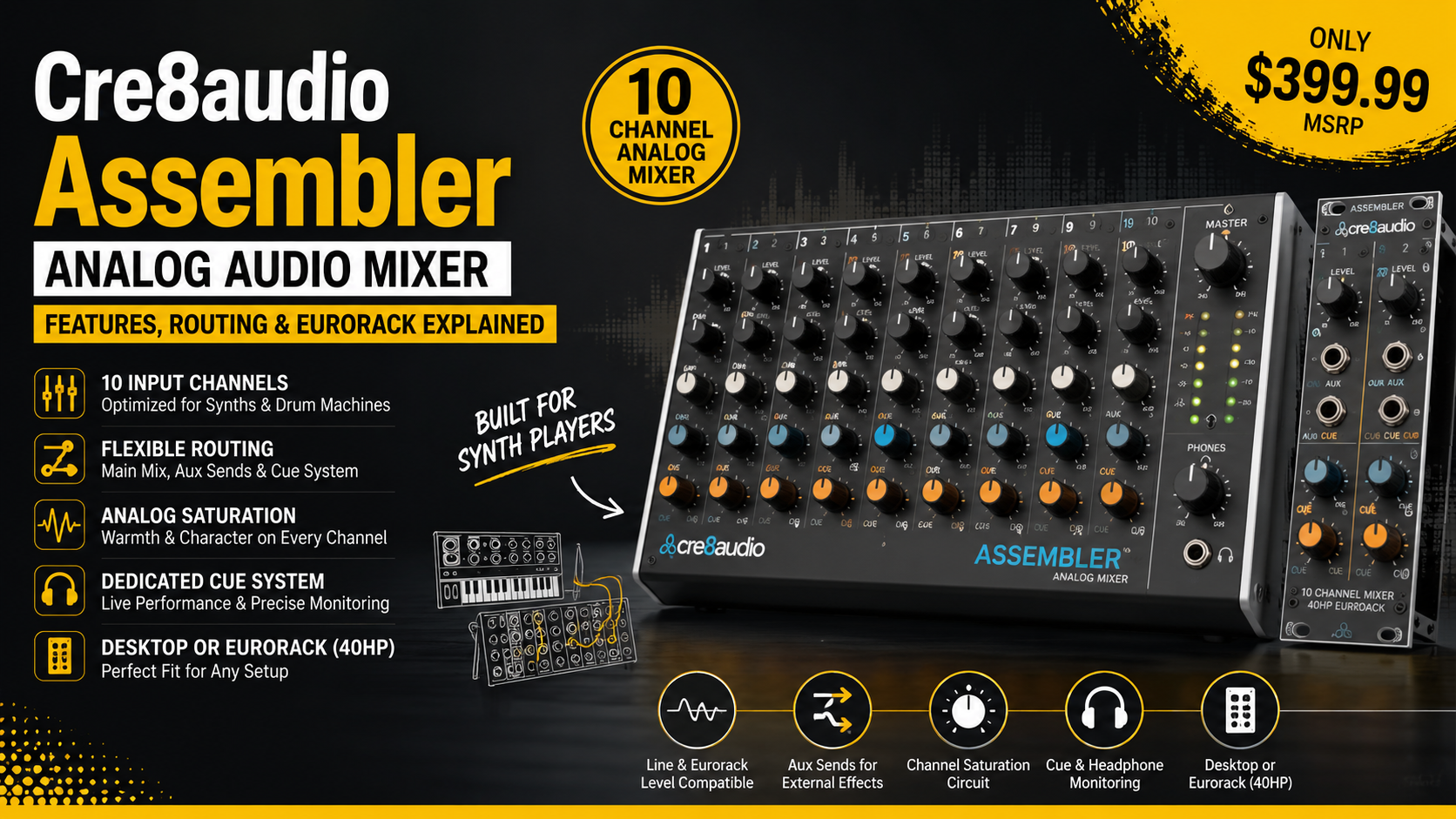
The Assembler was developed by Cre8audio in partnership with Pittsburgh Modular Synthesizers and is available as a desktop mixer in its own enclosure or as a 40HP Eurorack module. Cre8audio currently lists the mixer at $399.99 MSRP and identifies firmware v2.1 as the latest firmware download on its product page.
For musicians searching specifically for a Cre8audio Assembler analog audio mixer, the most important point is that this is not simply a generic 10-channel mixer squeezed into a Eurorack-friendly box. Its channel layout and routing are deliberately optimized for synth-heavy setups, where signals may move between Eurorack and line-level equipment and where external effects and live performance control are important.
What Is the Cre8audio Assembler?
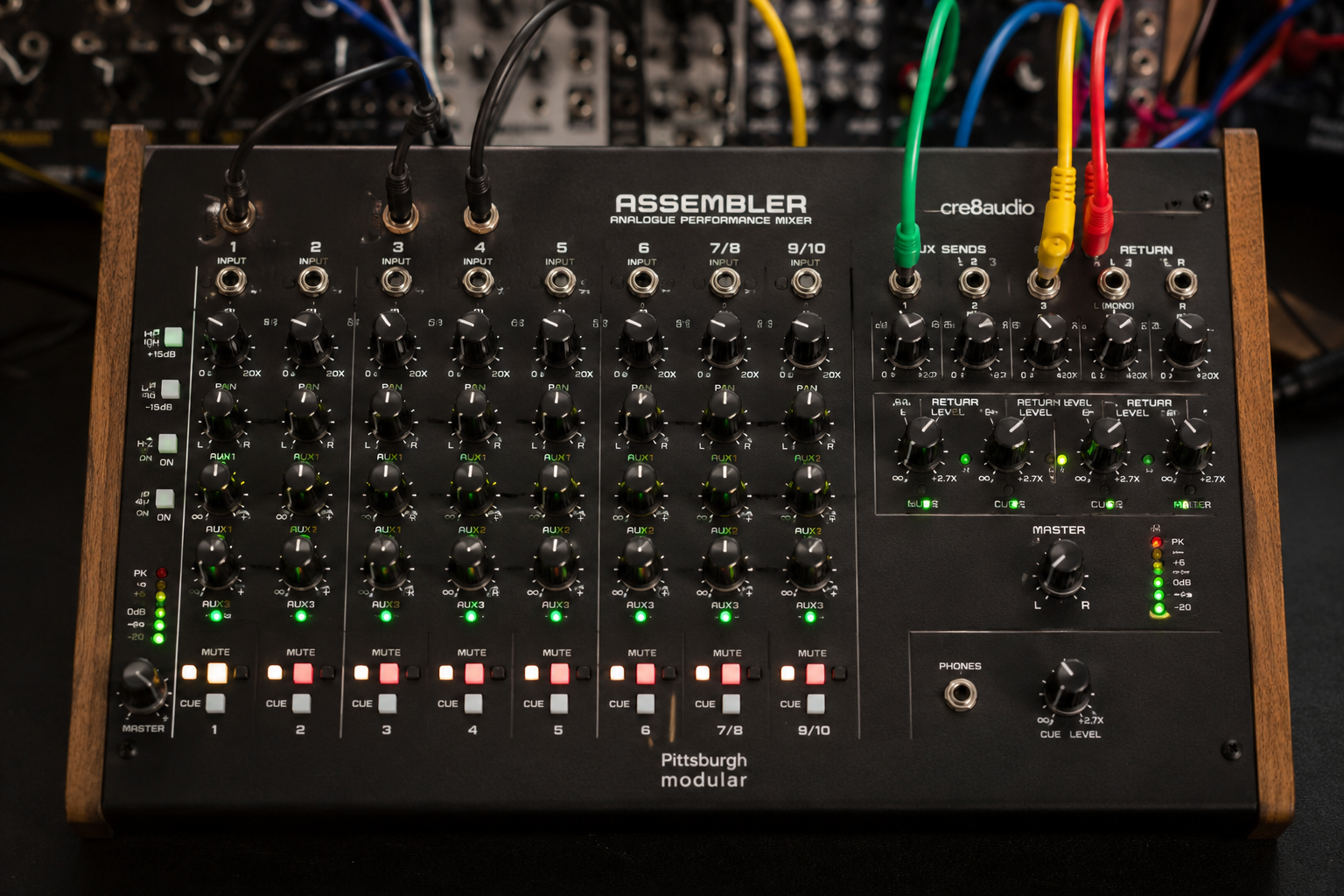
The Cre8audio Assembler is a 10-channel analog mixer with six mono inputs and two stereo input pairs. The six mono channels are numbered 1 through 6, while channels 7/8 and 9/10 can operate as stereo pairs or accept mono signals.
Its main purpose is straightforward: connect several synthesizers, drum machines, samplers, Eurorack voices, or other audio sources, control their levels and stereo position, send selected signals to effects or submixes, and combine everything into a stereo main output.
What makes the Assembler unusual is how much of this functionality fits into a relatively small surface. It provides three auxiliary sends, auxiliary returns, channel mutes, cue monitoring, per-channel gain boosting, LED metering, and EQ on the first two channels, while remaining small enough to fit into a Eurorack system.
Cre8audio describes the design as a combination of modern workflow and vintage-inspired analog sound shaping, including signal contouring and soft compression intended to evoke the behavior associated with classic mixing equipment.
Cre8audio Assembler Specifications at a Glance
| Feature | Cre8audio Assembler |
|---|---|
| Mixer type | Analog mixer |
| Audio inputs | 10 channels |
| Mono channels | 6 |
| Stereo channels | 2 stereo pairs |
| Aux sends | 3 mono, post-fader |
| Aux returns | 2 stereo + 1 mono |
| EQ | High/Low EQ on channels 1–2 |
| Channel pan | Mono channels 1–6 |
| Gain boost | Up to 20× |
| Main output | Stereo |
| Headphones | Stereo output with separate cue system |
| Eurorack width | 40HP |
| Eurorack depth | 30mm |
| Eurorack power | +12V 380mA, -12V 275mA |
| Dimensions | 207 × 138 × 61mm |
| Weight | 845g |
| Standalone operation | Yes, included case |
| Current manufacturer MSRP | $399.99 |
Specifications are based primarily on Cre8audio’s current product information.
How the 10 Channels Are Organized
The Assembler does not give every input exactly the same channel strip. Instead, it divides the mixer into three channel types.
Channels 1 and 2: the full-featured mono channels
Channels 1 and 2 are the most comprehensive strips on the mixer. Each includes a mono input, level control, pan, two-band EQ, auxiliary controls, gain boost, mute, cue routing, and LED metering.
Their high- and low-frequency controls are shelving EQs, meaning they broadly increase or decrease frequencies above or below a particular range rather than acting like a narrow parametric EQ.
The V1.0 user manual describes the high shelf as operating above 2.5 kHz and the low shelf below 200 Hz, with ±12 dB adjustment. However, Cre8audio’s current product page and several current dealer descriptions specify ±15 dB. Because the manufacturer’s current product page conflicts with the older V1.0 manual, the ±15 dB figure should be treated as the current advertised specification, while the discrepancy is worth noting for buyers who need exact EQ measurements.
Channels 3–6: simpler mono channels
Channels 3 through 6 remove the EQ section but retain the core mixing functions: level, pan, auxiliary sends, gain boost, mute, cue routing, and metering.
This arrangement makes sense for a synthesizer setup. You can put a lead synth, bass voice, drum machine output, or other important sound on channels 1 and 2 when you want immediate tonal shaping, while less demanding sources can occupy channels 3 through 6.
Channels 7/8 and 9/10: stereo-friendly inputs
The final four inputs are arranged as two pairs: 7/8 and 9/10. Each pair can operate as a stereo channel, while the left input can also be used as a mono input. The manual explains that the left input is internally connected to the right input for mono operation.
This is particularly useful for equipment such as stereo synthesizers, digital effects, grooveboxes, samplers, and other devices that produce left/right outputs.
The stereo channel strips have their own level and auxiliary controls, gain boost, mute, and cue functionality, but they do not provide the dedicated high/low EQ found on channels 1 and 2.
What Does the 20× Gain Boost Do?
One of the Assembler’s most important features is the 20× gain boost available on its inputs.
Gain determines how strongly a signal is amplified. A synthesizer or other line-level source may already be strong enough for normal mixing, while a different source may require substantially more gain. In a Eurorack environment, the difference can be particularly important because modular equipment commonly operates at considerably higher signal levels than conventional studio line-level equipment.
Cre8audio says the Assembler’s preamps can provide up to 20× gain boost, allowing the mixer to accommodate line-level and Eurorack sources and, when driven harder, create more saturation.
The important distinction is that gain is not simply a volume control. Raising gain changes the level entering the following circuitry and can affect how hard that circuitry is driven.
For example, imagine a comparatively quiet external instrument entering channel 3. Gain boost can bring the signal into a more useful operating range. With a hot Eurorack source, on the other hand, deliberately pushing the gain can become part of the sound-design process.
The Assembler’s Vintage Sound Approach
Cre8audio does not present the Assembler as a transparent utility mixer alone. A major part of its identity is the vintage-inspired signal processing designed with Pittsburgh Modular.
The company describes custom circuitry using signal contouring and soft compression, combined with tape-saturation-style processing intended to produce more warmth, cohesion, and character. Importantly, this should not be interpreted as a literal magnetic tape machine built into the mixer. The documentation describes circuitry intended to emulate characteristics associated with vintage recording signal chains.
This matters because “analog warmth” is often used loosely in audio marketing. In practical terms, the Assembler gives you a signal path that can move from relatively clean operation toward more noticeable harmonic coloration as levels are pushed.
That makes the mixer potentially useful as a sound-shaping device, not just a place where signals are added together.
Three Aux Sends Make the Assembler More Than a Simple Mixer
The Assembler provides three mono auxiliary sends, and they are post-fader.
An auxiliary send is essentially an additional path that takes some amount of a channel’s signal and routes it somewhere else.
A familiar example is reverb:
Synth → Assembler channel → main mix
At the same time:
Synth → Aux Send → external reverb → Aux Return → main mix
This arrangement lets you keep the original synth signal while mixing in a processed version.
The Assembler’s three aux buses can also be used for external effects, submixing, or experimental routing. The mixer provides two stereo returns and one mono return, each with independent return-level control and up to 2.7× gain according to Cre8audio’s specifications.
The distinction between the auxiliary paths is important. Channels 1–6 have a dedicated Aux 1 control plus a second control that can be assigned between Aux 2 and Aux 3. The stereo channels can select among the three auxiliary sends using the control system.
Why Post-Fader Aux Sends Matter
“Post-fader” means the auxiliary signal follows the channel’s level control.
Suppose a synth’s channel level is reduced. The amount being sent through a post-fader auxiliary path also changes.
This is particularly convenient for effects such as reverb and delay, where you normally want the effect contribution to follow the source level.
It is less convenient when you specifically want a fixed effect-send level independent of the channel fader. A 2025 review by AMAZONA.de specifically noted the lack of pre-fader sends as a limitation.
That distinction is important for live performers who expect DJ-style or monitor-oriented pre-fader routing.
Cue Monitoring for Live Performance
Another major feature is the separate headphone cue system.
Cue monitoring means you can send selected channels to the headphone output for monitoring without necessarily changing what the audience hears through the main output. On the Assembler, the headphone output has its own level control, while individual channels can be assigned to the cue mix.
This can be valuable during a live modular performance.
For example, you might have several voices playing through the main output while preparing another sound. Sending the appropriate channel to the headphones allows you to check it before making a change to the live mix.
The cue system is therefore one reason the Assembler can make more sense for performance-oriented setups than a basic compact line mixer.
Channel Mutes and LED Metering
Every channel includes a mute function, and the mixer uses three-segment LED level indicators to provide visual feedback.
Three-segment metering is not a substitute for a detailed studio metering system, but it provides something especially useful in a compact performance mixer: a quick indication of whether a signal is present and how strongly it is being driven.
The illuminated channel controls also make muting individual instruments practical during live use.
For a synth performer, that can be as useful as traditional mixing adjustments. You might mute a percussion part for several bars, remove a bass line during a transition, or rapidly bring different voices in and out of a performance.
Using the Assembler With Eurorack
The Assembler’s strongest selling point is arguably its ability to function in both standalone and Eurorack environments.
As a Eurorack module, it occupies 40HP, has a listed depth of 30mm, and requires 380mA on +12V and 275mA on -12V, with no +5V requirement listed by Cre8audio. The manufacturer also specifies reverse-polarity protection.
The module can instead remain in its supplied standalone enclosure, making it useful for a desktop setup.
This dual-purpose design means you do not necessarily have to decide between a desktop mixer and a Eurorack mixer at purchase time. The same hardware can be integrated into a modular case later.
However, the power consumption is worth considering. 275mA on the -12V rail is substantial for a Eurorack module, so users should check their case’s available power budget before installation rather than assuming any case has sufficient headroom.
Using the Assembler With Line-Level Equipment
Although its design is closely associated with Eurorack, Cre8audio explicitly describes the Assembler as compatible with both Eurorack and line-level instruments.
That opens up several practical combinations:
A desktop setup might contain a drum machine on 7/8, a stereo synthesizer on 9/10, a mono bass synth on channel 1, and additional modular voices on channels 2–6.
The mixer can then act as the central point where these signals are combined, monitored, muted, routed through external effects, and sent to the final stereo output.
The important thing to understand is that connector format and electrical signal level are separate concepts. The presence of a 3.5mm jack does not automatically mean two devices use the same signal level, and the Assembler’s gain controls exist partly because different electronic instruments produce different signal strengths.
Is the Cre8audio Assembler Actually Useful for a Synth Setup?
The Assembler makes the most sense when a setup contains several hardware instruments and the user values hands-on control.
Its strengths are especially clear when you need multiple physical channels without navigating menus, software, or a DAW. The first two channels provide more tone-shaping control, the other mono channels provide straightforward mixing, and the stereo channels accommodate instruments that already have left/right outputs.
The combination of three aux buses, external returns, gain boosting, cue monitoring, mutes, and Eurorack integration also means the mixer can become part of the creative signal path rather than merely sitting at the end of it.
A 2025 review from Molten Music Technology described the Assembler as a compact Eurorack-focused desktop or modular mixer with a feature set well suited to the reviewer’s use cases, emphasizing its simplicity and physical accessibility.
Potential Limitations to Consider
The Assembler’s compactness comes with trade-offs.
The controls are physically close together, something noted in independent testing and user feedback. AMAZONA.de highlighted the tightly spaced controls and connectors as a potential handling problem, particularly for users with larger fingers or when many standard plugs are connected.
The mixer also does not offer a conventional full-featured EQ on every channel. Only channels 1 and 2 get the dedicated high/low EQ section. Channels 3–6 rely on level, pan, gain, and auxiliary routing rather than individual tone controls.
The auxiliary system is flexible, but the sends are post-fader, so users looking for extensive pre-fader monitoring options may prefer a different architecture.
Finally, the Assembler is intentionally focused on analog mixing and performance workflow. It does not attempt to replace a large digital console or DAW mixer with multitrack recording, digital effects libraries, automation, USB audio interfaces, or a huge collection of channel-processing functions.
That is not necessarily a weakness. It is a design choice.
Cre8audio Assembler vs. a Conventional Compact Mixer
The biggest difference is not simply the number of channels.
A typical compact mixer may be designed primarily around microphones, guitars, keyboards, stereo playback, and general-purpose live sound. The Assembler instead puts synthesizers and modular instruments at the center of its design.
| Consideration | Assembler | Typical compact mixer |
|---|---|---|
| Eurorack integration | Strong | Usually limited or absent |
| Hardware synth workflow | Strong | Varies |
| 3.5mm modular connections | Built around them | Often requires adapters |
| Analog hands-on control | Yes | Usually yes |
| Stereo synth inputs | Yes | Usually yes |
| Multiple aux sends | 3 | Depends on model |
| Cue monitoring | Yes | Model-dependent |
| Full EQ on every channel | No | More common |
| USB recording/interface functions | Not its focus | Common on some models |
| Eurorack installation | Yes, 40HP | Rare |
| Compact desktop use | Yes | Yes |
The best choice therefore depends less on the word “analog” and more on the instruments and workflow involved.
Who Should Buy the Cre8audio Assembler?
The Assembler is particularly compelling for a musician who owns multiple synthesizers, drum machines, or Eurorack voices and wants them under direct physical control.
It is also attractive to performers who need rapid access to mutes, levels, pan, aux routing, and cue monitoring without relying on a computer.
Another strong use case is a hybrid setup: a Eurorack case on one side, several desktop synthesizers on the other, and an external reverb or delay connected through the aux system.
For someone building a conventional recording studio around microphones, many fully featured channel strips, USB multitrack recording, and extensive digital processing, the Assembler may be less appropriate.
What the Current Firmware Situation Means
The Assembler is not completely independent of software. Cre8audio provides firmware updates, and the current Assembler product page links to firmware v2.1. Cre8audio’s firmware-and-software support page lists the Assembler firmware update with a December 2025 last-update date.
This does not turn the Assembler into a digital mixer. Rather, the firmware is associated with the product’s electronic control functionality, including features such as button-based routing and operating behavior.
Anyone purchasing a new unit should therefore check Cre8audio’s current support page rather than assuming the firmware shipped on an older unit is the newest version.
Is the Cre8audio Assembler Worth It?
The answer depends heavily on the type of setup.
For a Eurorack-heavy or hardware-synth performance rig, the Assembler’s combination of 10 channels, three auxiliary sends, stereo inputs, gain boosting, cue monitoring, mutes, analog saturation-style processing, and removable 40HP format gives it a very specific advantage: it brings many of the functions musicians actually need into a compact physical mixer designed around electronic instruments.
Its limitations are equally specific. The compact control layout can feel crowded, only two channels have dedicated EQ, the auxiliary sends are post-fader, and it is not intended to be a comprehensive computer recording interface or large-format studio console. Independent reviews have also praised its feature density while pointing out some of these ergonomic compromises.
In other words, the Assembler is most convincing when viewed not as a universal mixer but as a dedicated synth and Eurorack performance mixer with analog sound-shaping capabilities.
Frequently Asked Questions
Is the Cre8audio Assembler an analog mixer?
Yes. Cre8audio describes the Assembler as a vintage analog audio mixer, with analog signal-processing circuitry designed to provide vintage-inspired contouring, soft compression, and saturation characteristics.
How many channels does the Assembler have?
It has 10 audio channels: six mono inputs and two stereo pairs, 7/8 and 9/10. The stereo pairs can also accept mono sources through their left inputs.
Can the Cre8audio Assembler be installed in Eurorack?
Yes. The mixer can be removed from its supplied standalone enclosure and installed as a 40HP Eurorack module. Cre8audio lists a 30mm module depth and power consumption of 380mA at +12V and 275mA at -12V.
Can it mix ordinary line-level synthesizers?
Yes. Cre8audio explicitly states that the Assembler supports line-level and Eurorack signals, making it suitable for hybrid desktop and modular setups.
Does the Assembler have EQ on every channel?
No. Dedicated high- and low-frequency EQ controls are provided on channels 1 and 2. Channels 3–6 provide mixing, pan, gain, auxiliary, mute, cue, and metering functions, while 7/8 and 9/10 are stereo-oriented channels with their own routing controls.
How many effects sends does it have?
There are three mono post-fader auxiliary sends. Aux 1 and Aux 2 have stereo returns, while Aux 3 has a mono return.
Does it have a headphone cue system?
Yes. The Assembler provides a dedicated stereo headphone output with a separate cue system, allowing selected channels to be monitored independently from the main mix.
Does the Assembler have USB audio or a built-in audio interface?
The current Cre8audio specifications focus on the Assembler as an analog mixer with main outputs, auxiliary routing, returns, and headphone monitoring; USB audio-interface functionality is not listed among its specifications.
What is the current price of the Cre8audio Assembler?
Cre8audio currently lists an MSRP of $399.99 on its official product page and company store. Actual retailer pricing can vary by region and seller.
What is the latest Assembler firmware?
Cre8audio’s current Assembler product page links to firmware v2.1. Its support page identifies the Assembler firmware update as last updated in December 2025.
Bottom Line
The Cre8audio Assembler analog audio mixer occupies a fairly specific niche: it is a compact, hands-on mixer built around the needs of synthesizers, Eurorack instruments, desktop electronic-music rigs, and live performance.
Its strongest features are the 10-channel layout, three post-fader aux buses, external effect returns, 20× input gain boost, vintage-inspired analog processing, channel mutes, cue monitoring, stereo inputs, and the ability to operate either as a desktop mixer or a 40HP Eurorack module.
Its compromises—particularly tight physical spacing, limited channel-by-channel EQ, and post-fader-only aux sends—are important to understand before buying.
For the right setup, however, the Assembler’s appeal is straightforward: it gives a hardware synth rig a compact central mixing surface without forcing the workflow into a computer or a conventional large-format console.
Also Read: JSON Syntax Square Brackets | What [ ] Mean in JSON

1 Comment
Pingback: Networking and the Internet at CMU | 15-441 and 15-641 Explained