


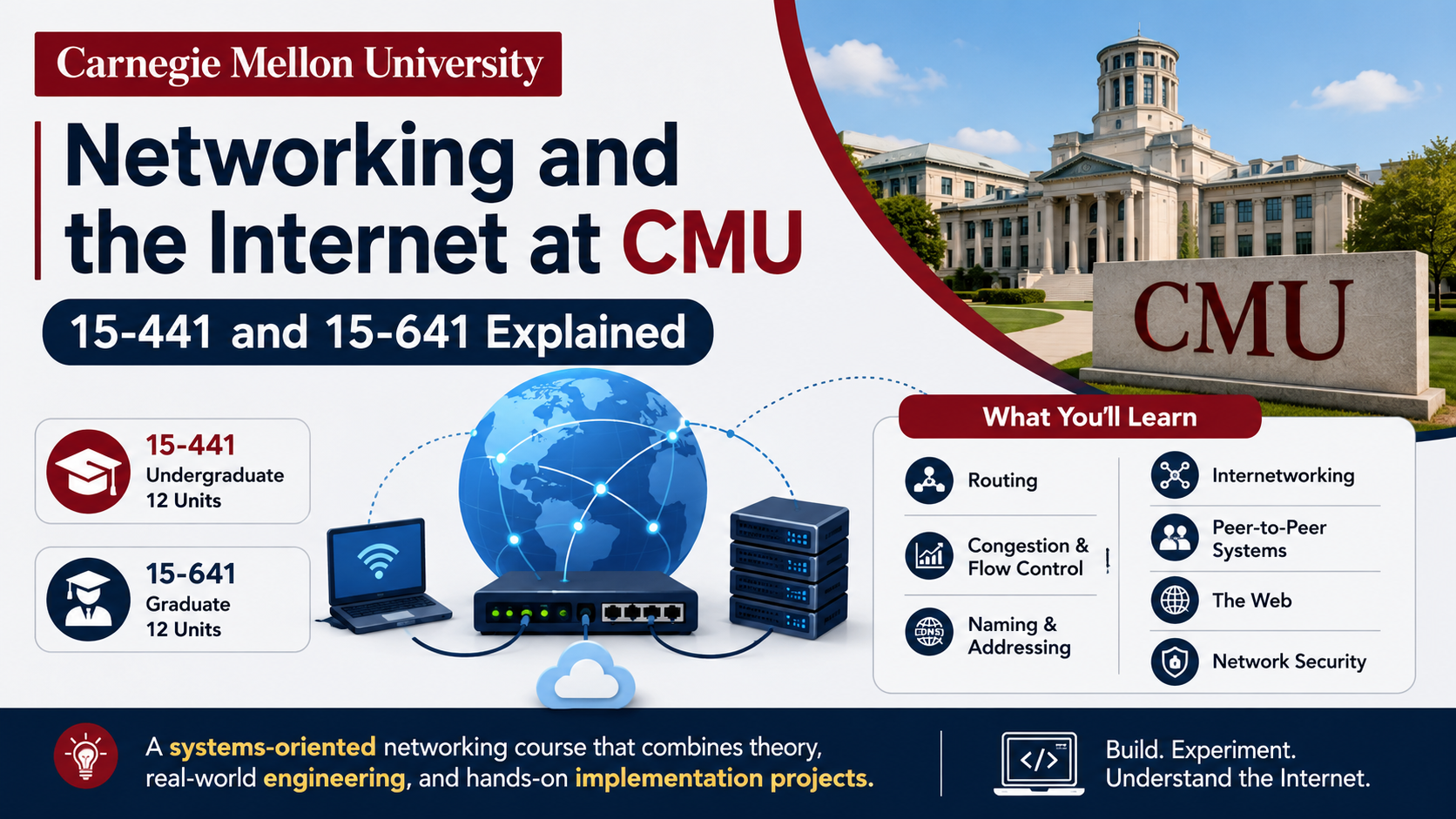
Networking and the Internet at Carnegie Mellon University (CMU) is the university’s core computer-networking course sequence focused on understanding how computer networks work, why they are engineered the way they are, and how modern Internet systems are built. For undergraduates, the course is 15-441; the graduate version is 15-641. Both carry 12 units and emphasize not just networking theory, but the engineering trade-offs involved in designing and implementing networks.
For students searching for “networking and the internet CMU,” the important point is that this is not simply a course about configuring routers or memorizing TCP/IP terminology. CMU presents it as a systems-oriented networking course with multi-week implementation projects, covering areas such as routing, congestion and flow control, naming and addressing, internetworking, peer-to-peer systems, the Web, and network security.
What Is CMU Networking and the Internet?
Carnegie Mellon’s Networking and the Internet course studies the fundamental mechanisms that allow computers and networks to communicate. The official description emphasizes the performance and engineering trade-offs involved in building computer networks, meaning students are expected to understand not just what a protocol does, but why a particular design was chosen and what compromises it creates.
That distinction is important. A network can be made faster, more reliable, more secure, more efficient, or more flexible, but improving one property can sometimes make another harder to achieve. For example, adding mechanisms for reliability can introduce overhead, while aggressive congestion control can affect throughput and delay. Networking therefore becomes a systems-design problem rather than a collection of isolated protocols.
CMU also explicitly connects classroom concepts to the real Internet. The course description says that examples are drawn primarily from the Internet and that students should understand how networks work today as well as why they are designed that way and how they may evolve in the future.
15-441 vs. 15-641: What Is the Difference?
The most important distinction is the student level.
| Course | Audience | Units | Main purpose |
|---|---|---|---|
| 15-441 Networking and the Internet | Undergraduate | 12 | Core networking and Internet concepts with substantial implementation work |
| 15-641 Networking and the Internet | Graduate | 12 | Graduate version of the networking course sequence |
CMU’s course pages explicitly state that 15-441 is intended for undergraduates, while 15-641 is intended for graduate students.
The two course numbers should therefore not be treated as unrelated networking classes. They represent CMU’s undergraduate and graduate versions of Networking and the Internet.
The course is also relevant beyond students specializing in networking. CMU includes 15-441 among systems-oriented courses in its Computer Science curriculum, alongside subjects such as operating systems, distributed systems, computer architecture, and databases.
What Does CMU Networking and the Internet Teach?
The official CMU description identifies several major areas.
Network Architecture
Network architecture is the overall organization of a network: how responsibilities are divided between different layers and components, how hosts communicate, and how independent networks can work together.
A useful way to picture this is as a layered system. One part of the stack may deal with moving data across a local link, another with delivering packets between networks, and another with providing applications with reliable communication.
Layering helps engineers change one part of a system without redesigning everything above and below it.
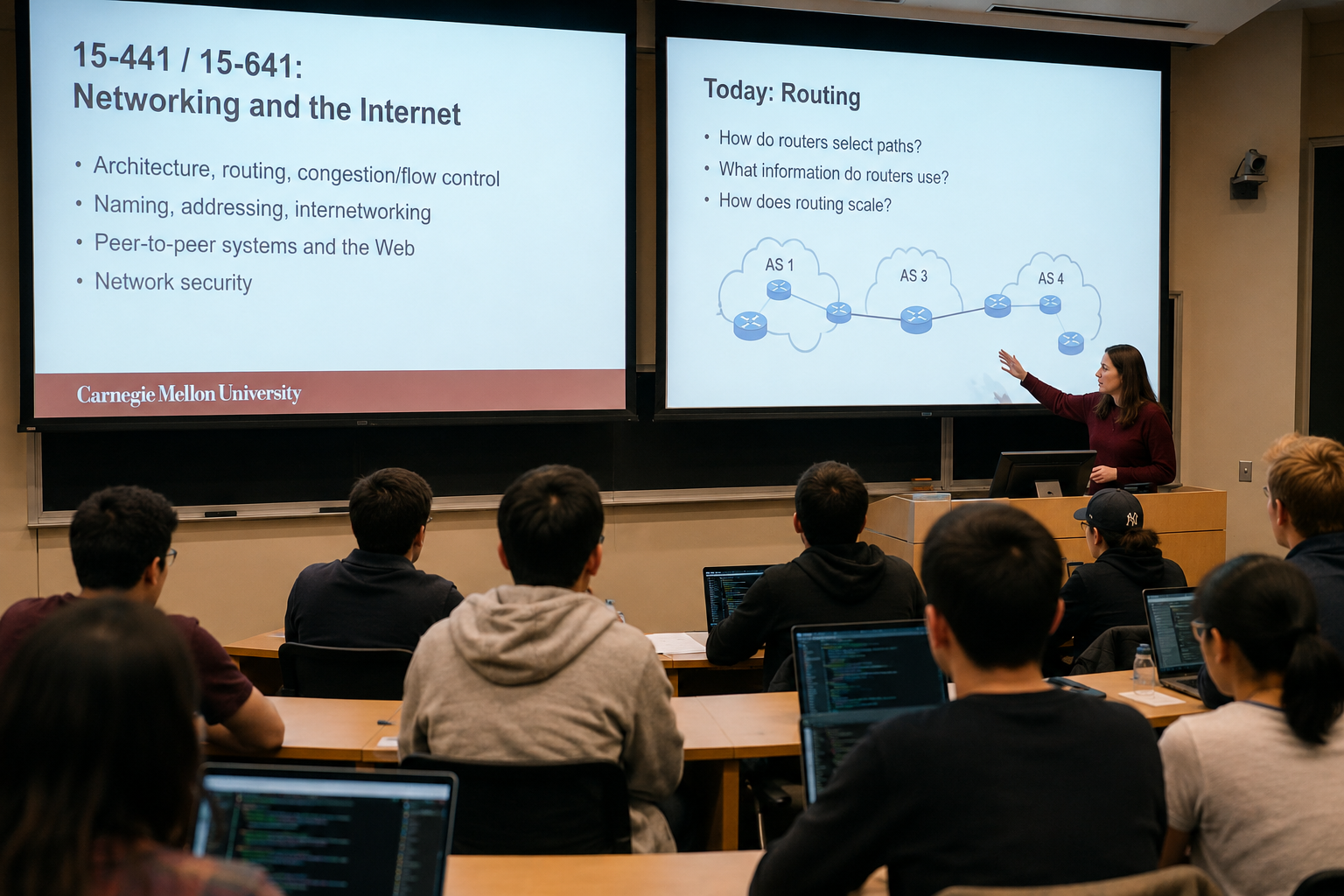
Routing
Routing determines where network traffic should go.
When a device sends data to an Internet destination, the data normally crosses multiple network devices and potentially multiple independent networks. Routers use routing information to select paths through this interconnected system.
The challenge is not simply finding a route. Real networks have to deal with changing conditions, failures, traffic loads, administrative policies, and scalability.
That is why routing is one of the central problems in computer networking and an explicit topic in CMU’s course description.
Congestion and Flow Control
A network may have enough capacity under normal conditions but become overloaded when too much traffic competes for the same resources.
This is the problem of congestion.
Networking systems need mechanisms that prevent traffic from overwhelming available capacity. Related concepts such as flow control help regulate how much data can be transmitted between communicating endpoints.
These mechanisms directly influence practical properties such as throughput, delay, fairness, and application responsiveness.
CMU specifically lists congestion/flow/error control among the course’s key topics.
Error Control
Network communication is not automatically perfect. Packets can be corrupted, lost, delayed, duplicated, or delivered out of order depending on the network technology and protocol involved.
Error control refers to mechanisms used to detect and, where appropriate, deal with these problems.
A reliable communication protocol may detect missing data and retransmit it, while another application may tolerate some loss in exchange for lower delay.
This is another example of the engineering trade-offs that sit at the center of the CMU course.
Naming and Addressing
Two concepts that beginners often confuse are naming and addressing.
An address identifies where a network endpoint can be reached within a particular networking system. A name provides a more human- or application-oriented way to identify a resource.
The Internet makes this distinction especially visible with systems such as DNS, where human-readable domain names are translated into network addresses.
CMU specifically includes both naming and addressing in the Networking and the Internet curriculum.
Peer-to-Peer Systems and the Web
Networking is not limited to routers and low-level packet forwarding.
Modern Internet communication also involves peer-to-peer systems, Web applications, distributed services, content delivery, and other application-level technologies.
By including peer-to-peer and the Web, the course connects the underlying networking mechanisms to systems that users interact with directly.
Internetworking
The Internet is not one gigantic network operated as a single homogeneous system.
It is an interconnection of networks operated by different organizations, using common protocols and agreements that allow those networks to communicate.
That makes internetworking a fundamental topic. Students need to understand how separate networks can participate in a larger communication system without becoming one physically identical network.
Network Security
Networking and security are inseparable.
Once computers communicate over shared infrastructure, attackers may attempt to intercept, modify, impersonate, disrupt, or otherwise interfere with communications.
CMU explicitly includes network security in the course topics.
Importantly, security in networking is broader than simply encrypting traffic. It also involves authentication, trust, attack surfaces, protocol design, traffic analysis, denial-of-service threats, isolation, and the consequences of failures.
Why the Course Emphasizes Engineering Trade-Offs
The phrase “engineering trade-offs” is one of the most important clues to understanding CMU’s approach.
Suppose a protocol designer wants highly reliable communication. The obvious solution is to add mechanisms for acknowledgement, retransmission, ordering, and error detection.
But those mechanisms consume bandwidth, processing time, memory, and sometimes additional round trips.
Similarly, a system designed to minimize latency may make different choices from one designed primarily for maximum throughput.
Networking therefore involves questions such as:
What should happen when packets are lost?
How should bandwidth be shared between competing flows?
How much state should a router maintain?
Where should reliability be implemented?
How should a network react to congestion?
How can independent networks cooperate?
How can security be added without making the system unusably expensive or complex?
These are exactly the kinds of decisions the CMU course is designed to illuminate. The university says students should understand not only how networks operate today, but why they have their current designs.
CMU Networking Is More Than a Theory Course
A major reason the course stands out is its implementation component.
CMU’s official description says the class includes several multi-week projects requiring significant design and implementation.
This practical component matters because networking concepts can look deceptively simple on paper.
It is easy to understand a diagram showing packets moving between hosts. It is much harder to build software that correctly handles real packet-processing behavior, routing decisions, protocol state, timing, failures, and security considerations.
CMU’s publicly maintained networking-course GitHub organization provides concrete evidence of this practical orientation. Its repositories include public project templates such as cmu-mixnet, cmu-tcp, and cmu-http. The organization also lists current Fall 2026 course repositories, including 15-441-fa26 and a corresponding course website repository updated in August 2026.
The public repository list should not be interpreted as a complete official list of every current assignment, however. Projects can change from semester to semester.
How Difficult Is CMU Networking and the Internet?
This course is best understood as a systems-heavy computer science class, not an introductory “how the Internet works” survey.
Historical CMU course materials explicitly describe the substantial programming requirements, and CMU’s broader systems curriculum places networking after systems-level preparation. Current course information also describes multi-week design and implementation projects.
Students who have only learned networking concepts from introductory tutorials may therefore find the course challenging.
The difficult part is often the combination of:
- networking theory,
- systems programming,
- debugging,
- protocol behavior,
- performance analysis,
- concurrent or stateful software,
- and large implementation projects.
Understanding what TCP is is very different from having enough systems knowledge to reason about a network protocol implementation.
What Are the Prerequisites?
Networking and the Internet sits on top of systems knowledge.
CMU’s undergraduate networking materials have historically required Introduction to Computer Systems, offered under course numbers including 15-213, 18-213, and 15-513.
CMU’s catalog also places 15-441 within its systems-oriented Computer Science coursework, reinforcing that the course is intended for students with a solid systems background rather than complete beginners.
For graduate students, CMU’s Information Networking Institute currently lists 15-641 Networking and the Internet as one of its networking-core choices in the 2026–27 curriculum.
Because prerequisites and registration rules can vary by program and academic year, students should verify the requirements for their specific CMU program before registration.
What Is New for Fall 2026?
As of September 1, 2026, Carnegie Mellon’s Computer Science Department lists 15-441 Networking and the Internet in its Fall 2026 course offerings as a 12-unit course. The same Fall 2026 listing includes 15-641 for graduate students.
The Fall 2026 undergraduate course listing identifies Justine Sherry as the instructor for Networking and the Internet. The graduate 15-641 page likewise identifies Justine Sherry for Fall 2026.
The course’s core description remains focused on network architecture, routing, congestion and flow control, naming and addressing, peer-to-peer systems and the Web, internetworking, and network security.
The current public course GitHub organization also shows active Fall 2026 materials, with the 15-441-fa26 repository updated in August 2026.
That combination is useful for prospective students: the course is active in Fall 2026, its networking curriculum remains systems-oriented, and its project infrastructure is being maintained for the current semester.
Who Should Take CMU Networking and the Internet?
The course is a strong fit for students who want to understand the infrastructure behind modern software systems.
It is particularly relevant to students interested in:
Network engineering. You learn the principles behind routing, transport, addressing, network architecture, and traffic management.
Distributed systems. Distributed applications depend on communication between machines, making networking fundamentals essential.
Cloud infrastructure. Modern cloud systems rely heavily on data-center networking, traffic management, service communication, and failure handling.
Cybersecurity. Network behavior, protocols, traffic, and attack surfaces are central to security engineering.
Systems programming. The implementation-heavy projects provide experience working closer to the underlying machinery of software communication.
Internet infrastructure and research. Understanding networking fundamentals is valuable when working on routers, protocols, overlays, content distribution, edge systems, and other large-scale systems.
CMU itself places networking alongside other core systems courses such as operating systems, distributed systems, parallel computer architecture, and databases.
What Skills Can You Expect to Build?
The official course description does not promise a simple checklist of job skills, but its goals and project structure point toward several practical capabilities.
A student working through the course can expect to strengthen their ability to reason about network protocols, packet movement, routing, congestion, addressing, naming, internetworking, and security.
The multi-week projects also make implementation and debugging an important part of the experience rather than an optional extra.
That combination is valuable because production networking problems rarely stay entirely inside a textbook category. A performance problem might involve a protocol, a routing decision, software behavior, congestion, or an unexpected interaction between multiple layers.
How to Prepare for CMU 15-441
A strong preparation strategy is to make sure the fundamentals are already comfortable before the semester starts.
Review C and systems programming
Networking projects can involve low-level programming concepts such as memory management, pointers, sockets, buffers, and debugging.
The goal is not to become a C language expert overnight. The goal is to make C and basic Unix development familiar enough that programming syntax does not distract you from understanding networking.
Understand operating-system basics
You should be comfortable with processes, threads, system calls, memory, file descriptors, and basic debugging concepts.
This background helps because network software interacts closely with the operating system.
Learn the TCP/IP model
Before the course begins, understand the broad roles of:
Link layer — communication across a local network technology.
Internet layer — moving packets between networks.
Transport layer — communication between application endpoints.
Application layer — protocols and services used by applications.
Do not worry about memorizing every protocol field initially. Focus on understanding which problem each layer is trying to solve.
Practice reading network traffic
Basic familiarity with packets, ports, IP addresses, TCP connections, DNS requests, and HTTP traffic can make lectures and projects much easier to follow.
The objective is to be able to look at a packet or connection and ask: What layer am I looking at, and what job is this information performing?
Expect debugging to be part of learning
Networking software often fails in ways that are not obvious.
A program may appear correct for one test but fail under packet loss, reordered packets, concurrent connections, timing differences, or unexpected input.
Learning to use a debugger, logging, packet inspection, and systematic testing is therefore as important as memorizing protocol definitions.
Common Misunderstandings About the Course
“Is this just an Internet fundamentals course?”
No. It introduces networking fundamentals, but CMU explicitly emphasizes engineering and implementation, including significant multi-week projects.
“Is 15-441 only about routers?”
No. Routing is one component. The curriculum also covers congestion and flow control, naming and addressing, peer-to-peer systems, the Web, internetworking, and security.
“Are 15-441 and 15-641 completely different classes?”
No. They are the undergraduate and graduate versions of Networking and the Internet at CMU. The university explicitly directs undergraduate students to 15-441 and graduate students to 15-641.
“Do I need to know everything about computer networks first?”
Not necessarily, but you should have a strong systems background. CMU’s course structure assumes preparation in computer systems, and the implementation requirements make programming and debugging skills particularly important.
“Can I learn networking without programming?”
You can learn networking concepts without being a programmer, but that is not the same as being prepared for CMU’s course. The university specifically emphasizes design and implementation projects, so programming competence is an important part of succeeding in the class.
Why CMU’s Approach Matters
One of the most useful aspects of the course is its focus on why networks work the way they do.
A beginner might learn that TCP provides reliable communication, that IP uses addresses, or that routers forward packets.
An engineer needs to go further:
Why is reliability implemented there?
What happens when packets arrive out of order?
Why does congestion affect application performance?
What assumptions does a protocol make about the network?
What happens when those assumptions are wrong?
How does a design behave when the network becomes very large?
What are the security consequences of a seemingly reasonable protocol decision?
Those questions turn networking from memorization into engineering.
That is closely aligned with CMU’s stated course goal: students should understand how networks work, why they are designed as they are, and how they may evolve.
CMU Networking and the Internet: Key Facts at a Glance
| Item | Current information |
|---|---|
| Course name | Networking and the Internet |
| Undergraduate course | 15-441 |
| Graduate course | 15-641 |
| Units | 12 |
| Current Fall 2026 instructor | Justine Sherry |
| Main emphasis | Network design, implementation, performance, and engineering trade-offs |
| Major topics | Architecture, routing, congestion/flow/error control, naming, addressing, peer-to-peer, Web, internetworking, security |
| Projects | Several multi-week design and implementation projects |
| Undergraduate audience | 15-441 |
| Graduate audience | 15-641 |
These details come from CMU’s current course pages and Fall 2026 Computer Science listings.
FAQ
What is “Networking and the Internet” at CMU?
It is a Carnegie Mellon Computer Science course focused on the design and implementation of computer networks, using the Internet as a major source of real-world examples. It covers architecture, routing, congestion and flow control, naming, addressing, Web and peer-to-peer systems, internetworking, and security.
What is CMU 15-441?
15-441 is the undergraduate version of Networking and the Internet. CMU lists it as a 12-unit course with significant multi-week implementation projects.
What is CMU 15-641?
15-641 is the graduate version of Networking and the Internet. CMU explicitly directs graduate students to 15-641 rather than 15-441.
Is CMU 15-441 difficult?
It can be demanding because the course combines networking concepts with substantial software design, implementation, and debugging. Students with strong systems-programming preparation are better positioned to handle the project workload.
Does CMU Networking and the Internet include projects?
Yes. CMU’s official description says the course contains several multi-week projects requiring significant design and implementation. Public CMU networking repositories also show project templates associated with areas such as Mixnet, TCP, and HTTP.
What should I know before taking 15-441?
A strong foundation in computer systems and systems programming is advisable. CMU’s course materials have historically identified Introduction to Computer Systems, including 15-213/18-213/15-513 equivalents, as prerequisite preparation.
Is Networking and the Internet useful for cybersecurity?
Yes. Network security is explicitly part of the course, and understanding protocols, addressing, routing, traffic, and communication behavior provides important systems-level background for security work.
Is CMU Networking and the Internet relevant in 2026?
Yes. The course remains part of CMU’s Fall 2026 Computer Science curriculum, and the university’s networking-course GitHub organization has active Fall 2026 repositories.
Final Takeaway
CMU Networking and the Internet is best understood as a serious systems course about how modern computer networks are engineered—not merely a beginner’s guide to the Internet.
For undergraduates, the relevant course is 15-441; for graduate students, it is 15-641. The curriculum combines fundamental networking concepts with the practical realities of routing, congestion, naming, addressing, internetworking, security, and protocol implementation, backed by substantial project work.
As of Fall 2026, the course remains an active part of CMU’s Computer Science offerings, with current course infrastructure and project repositories available publicly.
For anyone researching “networking and the internet CMU,” “CMU 15-441,” “CMU 15-641,” or “Carnegie Mellon computer networking,” the key takeaway is simple: this course is designed to teach not just what networking protocols do, but how to reason about the engineering decisions that make large-scale networks work.
Also Read: Cre8audio Assembler Analog Audio Mixer | Features, Routing and Eurorack
