


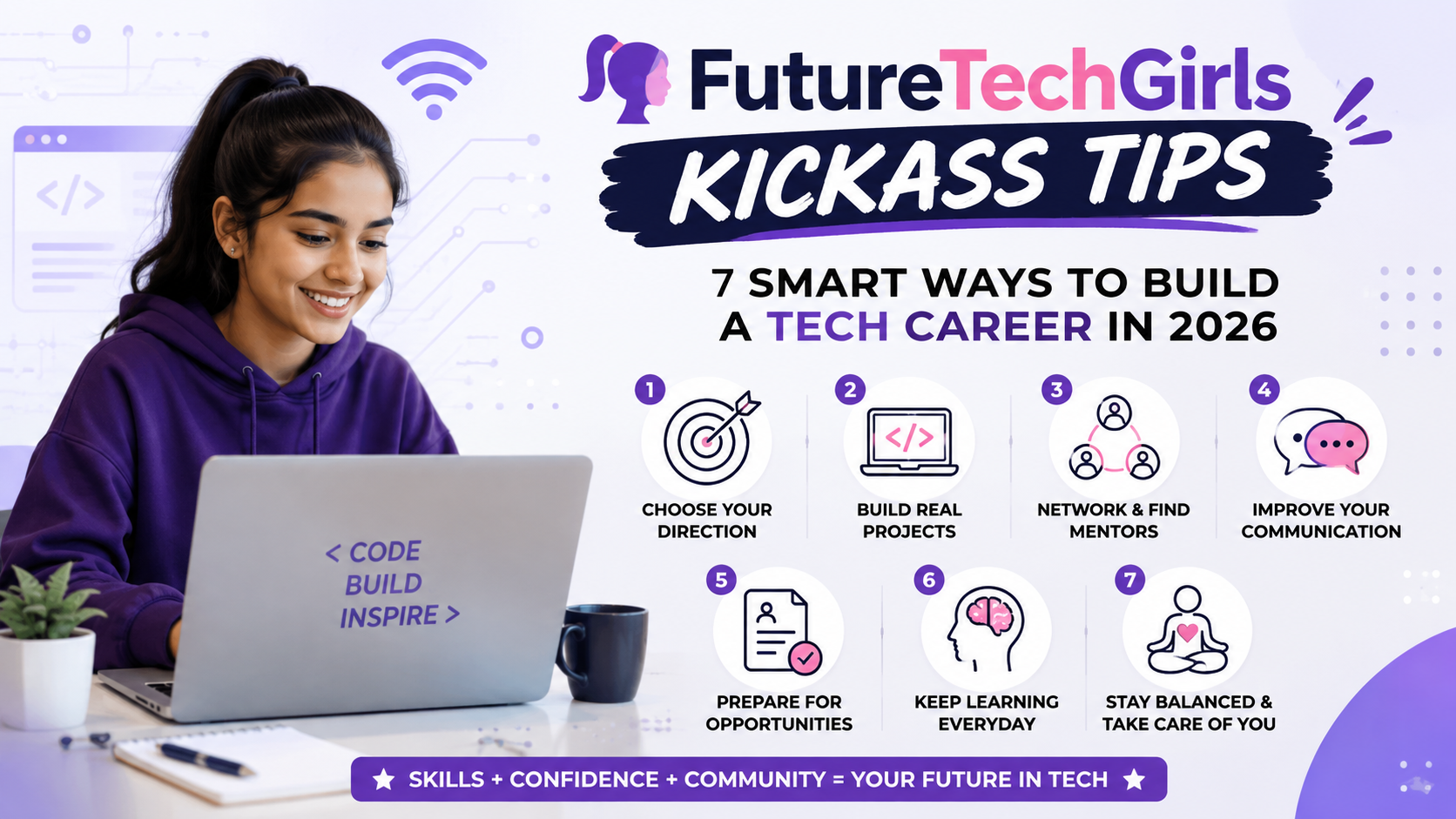
The phrase “FutureTechGirls kickass tips” currently points most directly to FutureTechGirls.com’s Kickass Tips content, including its June 2026 guide on launching a technology career. The site’s current material focuses on a practical combination of technical skills, real projects, networking, communication, career preparation, and sustainable learning habits rather than trying to learn every technology at once.
That basic idea is increasingly relevant in 2026. The World Economic Forum’s Future of Jobs Report 2025 identifies AI and big data, networks and cybersecurity, and technological literacy among the fastest-growing skill areas, while analytical thinking, resilience, flexibility, creative thinking, and lifelong learning remain important human capabilities.
For girls and young women, the challenge is not simply learning technology. Access, confidence, stereotypes, mentorship, and career opportunities still influence who enters and stays in STEM. UNESCO reports that women represent only about 35% of STEM graduates globally, with persistent underrepresentation in technology-related fields.
The most useful interpretation of the FutureTechGirls kickass tips is therefore simple: choose a direction, build evidence that you can do the work, make useful connections, learn continuously, and protect the energy required to keep going.
What Are the FutureTechGirls Kickass Tips?
FutureTechGirls currently uses “Kickass Tips” as one of its main content categories. Its June 2026 career guide recommends a flexible skill roadmap, practical projects, networking, stronger communication, and routines that reduce burnout. Another June guide emphasizes personal branding, high-impact technical skills, mentorship, job applications, portfolios, and interview preparation.
The exact articles are best treated as career advice rather than an official technical standard or formal certification framework. Their strongest ideas become more useful when combined with current labor-market data and primary documentation from organizations such as GitHub, the World Economic Forum, UNESCO, and the U.S. Bureau of Labor Statistics.
Here are seven practical principles that capture the most useful part of the FutureTechGirls approach.
1. Choose a Direction Before You Choose Too Many Technologies
One of the biggest beginner mistakes is collecting technologies instead of developing capability.
A person might start learning Python on Monday, switch to JavaScript on Wednesday, experiment with React on Friday, watch an AI course the following week, and then decide to study cybersecurity. The result can be a large vocabulary of technology names but very little ability to build something independently.
The better approach is to start with a target role or problem area. For example, someone interested in software development could begin with Python or JavaScript, Git, basic databases, testing, and one suitable framework. Someone interested in data analysis might prioritize SQL, spreadsheets, statistics, Python, and visualization instead.
This matches the core idea in FutureTechGirls’ roadmap advice: map skills to a goal, concentrate on a manageable stack, review progress regularly, and adjust the plan rather than treating the first choice as permanent.
A useful 90-day plan might look like this:
| Period | Main Goal | Example Output |
|---|---|---|
| Weeks 1–4 | Learn fundamentals | Small exercises and notes |
| Weeks 5–8 | Apply the fundamentals | One complete mini-project |
| Weeks 9–12 | Improve and publish | Tested, documented project |
The key is not the exact 90-day number. The important principle is focused learning with a visible outcome.
2. Build Real Projects Instead of Collecting Tutorials
Tutorials are useful for learning concepts, but they do not fully demonstrate whether you can use those concepts without someone guiding every step.
A real project forces you to deal with the parts tutorials often simplify: requirements, bugs, design decisions, documentation, testing, deployment, and trade-offs.
FutureTechGirls specifically recommends projects that solve a problem rather than simply reproducing a tutorial, and suggests explaining project goals, technology choices, constraints, and lessons learned.
Consider the difference:
Weak portfolio project:
“Built a weather app by following a tutorial.”
Stronger portfolio project:
“Built a weather dashboard for travelers that caches recent forecasts, handles API failures, displays severe-weather alerts, and explains why the interface was designed in a particular way.”
The second example gives a reviewer something to evaluate. It demonstrates not only coding, but also problem solving and engineering judgment.
Your first projects do not need to be huge. A task manager, expense tracker, API-powered dashboard, accessibility-focused website, small automation tool, data analysis project, or simple game can be enough when the work is genuinely yours and clearly documented.
3. Turn Your Projects Into Evidence, Not Just Links
Creating a project is only half the job. You also need to make it easy for another person to understand what you built.
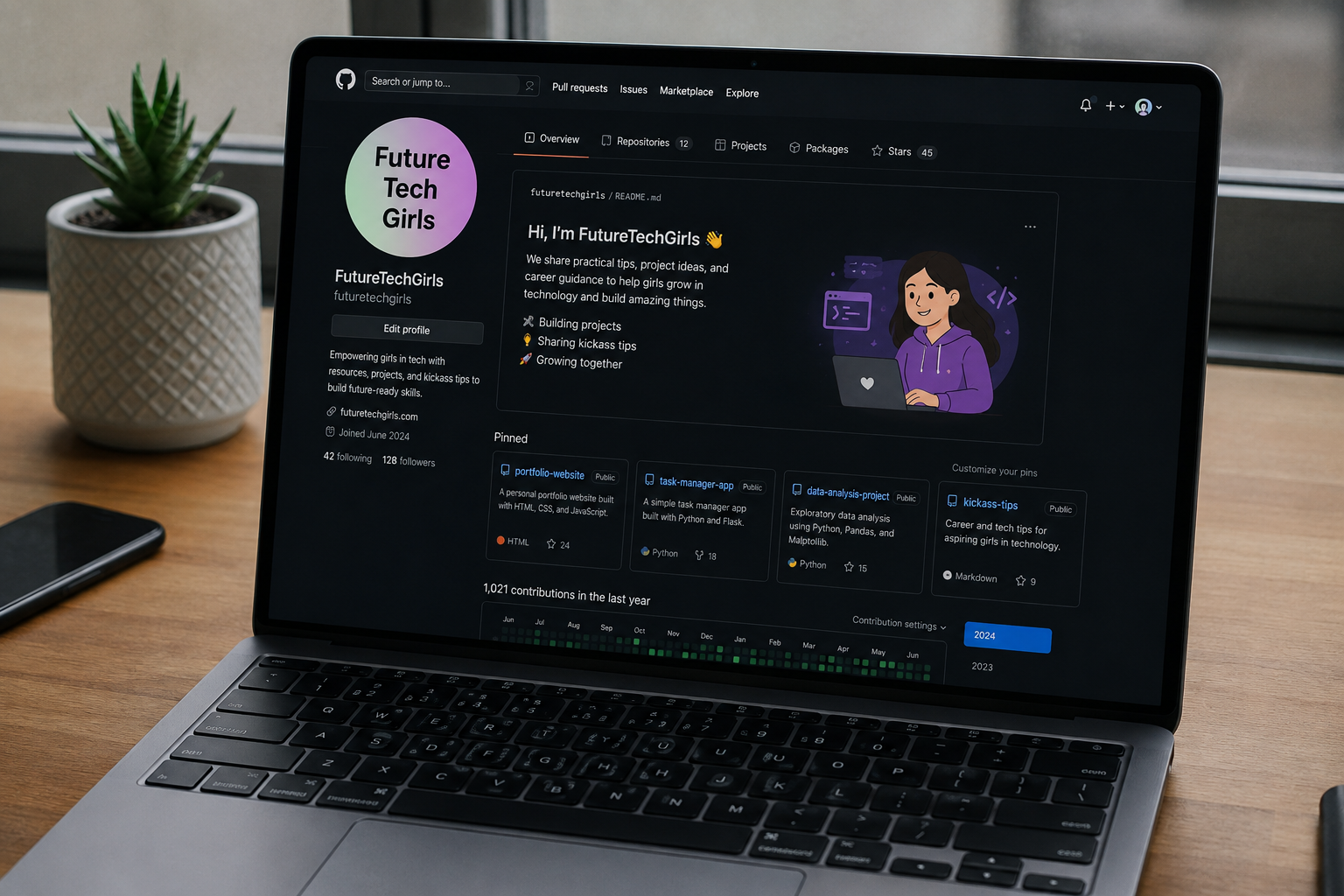
GitHub provides several mechanisms that are useful for this. A repository README can explain what a project does, why it is useful, how to get started, where users can get help, and how the project is maintained. GitHub also supports profile READMEs and pinned repositories so users can highlight work directly on their profiles.
A strong project page should answer five questions quickly:
What problem does this solve?
What did you personally build?
Which technologies did you use?
What was difficult or technically interesting?
How can someone see it working?
For a web application, that could mean a live demonstration, screenshots, source code, setup instructions, tests, and a short explanation of architectural decisions. For a data project, it might include the dataset source, methodology, visualizations, limitations, and conclusions.
FutureTechGirls’ advice also emphasizes short demos, project case studies, documentation, and visible work.
The goal is to replace vague statements such as “I know Python” with tangible evidence such as “Here are three projects in which I used Python to solve different problems.”
4. Learn the Technologies That Are Growing — but Do Not Ignore Fundamentals
The technology market is changing quickly, particularly around AI. The World Economic Forum reports that AI and big data are among the fastest-growing skills, alongside networks and cybersecurity and technological literacy. It also identifies analytical thinking, creative thinking, resilience, flexibility, and curiosity as important skills for the years ahead.
That does not mean every beginner needs to become an AI researcher.
The more useful strategy is to understand how modern tools fit into a broader technical foundation. Depending on the career path, that can include:
Programming fundamentals — variables, control flow, functions, data structures, and debugging.
Git and version control — tools for tracking changes to code and collaborating safely.
Databases and SQL — essential for storing, retrieving, and analyzing structured data.
APIs — interfaces that allow different software systems to communicate.
Testing — techniques for checking that software behaves as expected.
Security fundamentals — understanding common weaknesses and safer development practices.
GitHub provides free learning resources and GitHub Skills courses covering practical Git and GitHub workflows, including pull requests, open-source contribution, and GitHub Pages.
Security also deserves attention from the beginning. OWASP’s Top 10:2025 lists risks including broken access control, security misconfiguration, software supply-chain failures, cryptographic failures, injection, insecure design, and authentication failures.
The lesson is important: learn what is current, but build your career on fundamentals that remain useful when tools change.
5. Build a Network Through Contribution, Not Spam
Networking can sound intimidating, particularly for someone who is still a beginner.
It does not have to mean attending expensive conferences and handing out business cards. It can begin with a useful question in a developer community, contributing documentation to an open-source project, joining a study group, attending a local meetup, or asking someone for focused feedback.
FutureTechGirls recommends targeted communities, mentors, events, clear questions, consistent follow-up, and giving value back instead of treating every interaction as a request for a job.
GitHub also explicitly points learners toward open-source contribution and community participation as ways to develop experience and connect with other developers.
A good first message to a potential mentor is much more specific than:
“Can you mentor me?”
A stronger approach is:
“I’m building my first Python data project and I’m trying to improve the way I structure the code. Could you point out one area you would change?”
That request is specific, limited, and easy to answer.
Good networking is not about having hundreds of contacts. It is about developing a smaller group of genuine professional relationships.
6. Treat Communication as a Technical Skill
A strong developer, analyst, security engineer, designer, or technical specialist does not work in isolation.
Technology jobs frequently involve explaining decisions, writing documentation, reporting problems, reviewing changes, collaborating with teammates, and translating technical information for people who are not specialists.
The World Economic Forum’s latest skills analysis reinforces this point: alongside technology capabilities, employers continue to value analytical thinking, resilience, leadership, social influence, creative thinking, and adaptability.
This means writing deserves practice.
Learn to explain:
The problem: What was wrong or what needed to be built?
The options: What approaches were possible?
The decision: Why did you choose one?
The result: What happened?
The limitation: What still needs improvement?
This structure works in project documentation, interviews, pull requests, emails, presentations, and meetings.
It is also useful when applying for jobs. Instead of writing:
“Worked on a web application.”
write something more informative:
“Built and tested a web dashboard that retrieves customer data through an API and presents filtered results through a responsive interface.”
The second statement gives the reader evidence of what you actually did.
7. Protect Your Energy So Your Learning Can Continue
Perhaps the least glamorous part of a technology career is also one of the most important: you need enough energy to keep learning.
FutureTechGirls explicitly recommends sustainable routines, defined work blocks, rest, hobbies, realistic schedules, and paying attention to warning signs of burnout.
This matters because technology encourages endless comparison. There is always another framework, another AI model, another programming language, another certification, and another person who appears to be ahead.
Trying to catch everything at once can produce burnout rather than expertise.
A sustainable routine might be as simple as setting a fixed study period, choosing one primary learning objective, taking regular breaks, and reserving time away from screens. The exact schedule will differ between students, employees, parents, and career changers.
The important distinction is between intensity and consistency.
Studying twelve hours one weekend and nothing for the next month is usually less useful than developing a routine you can maintain over a much longer period.
Why These Tips Matter for Girls Entering Technology
The need for practical guidance is connected to a larger structural problem.
UNESCO reports that women remain underrepresented in STEM and identifies factors including gender stereotypes, social expectations, unequal access to opportunities, and limited encouragement or role models. Its recent work continues to emphasize mentorship, quality education, and visible examples of women in science and technology.
The issue is not that girls somehow need a fundamentally different version of programming or engineering.
They need access to the same technical opportunities, along with environments in which they can learn, experiment, make mistakes, find mentors, and see people like themselves succeeding.
That is why the combination of skills + projects + community + confidence is more valuable than motivational slogans alone.
What Should You Learn First in 2026?
There is no single perfect technology stack for every person. Your starting point should depend on the role you want.
| Career Direction | Useful Starting Foundation |
|---|---|
| Software development | Programming, Git, data structures, databases, testing |
| Web development | HTML, CSS, JavaScript, web fundamentals, Git, APIs |
| Data analysis | SQL, spreadsheets, statistics, Python, visualization |
| AI/ML | Python, mathematics, statistics, data handling, ML fundamentals |
| Cybersecurity | Networking, operating systems, Linux, authentication, security basics |
| UX/UI | User research, interface design, accessibility, prototyping |
| Cloud/DevOps | Linux, networking, Git, containers, automation, cloud fundamentals |
These are starting points rather than mandatory checklists. The fastest-growing technologies can change, but the ability to understand systems, reason about problems, communicate clearly, and learn new tools remains valuable. The World Economic Forum specifically identifies analytical thinking and technological literacy as important alongside rapidly growing AI, data, networks, and cybersecurity skills.
Do You Need a Computer Science Degree?
The answer depends heavily on the job and employer.
For software development, the U.S. Bureau of Labor Statistics reports that software developers, quality assurance analysts, and testers typically need a bachelor’s degree in computer and information technology or a related field, although hiring requirements vary between employers. The BLS currently projects 10% employment growth for the combined occupation group from 2025 to 2035, with about 106,100 openings per year on average over that period.
A degree therefore remains valuable for many technical career paths, but it should not be confused with the entirety of professional preparation.
Projects, internships, practical experience, communication skills, open-source contributions, and demonstrable technical ability can all strengthen a candidate’s profile.
The right approach is to understand the requirements of the specific role and market you are targeting rather than assuming that either “degrees do not matter” or “only degrees matter.”
A Simple FutureTechGirls 90-Day Action Plan
The most useful way to turn the FutureTechGirls kickass tips into action is to stop treating them as motivational advice and convert them into measurable work.
Days 1–30: Build the foundation
Choose one target role.
Identify the essential skills for that role.
Select one primary language or toolset.
Learn Git and basic command-line workflows.
Build small exercises rather than only watching tutorials.
Days 31–60: Build something real
Choose a project that solves a clearly defined problem.
Keep the scope small enough to finish.
Use documentation rather than copying every decision from a tutorial.
Add basic testing where appropriate.
Track bugs and improvements.
Days 61–90: Publish and connect
Clean up the code.
Write a useful README.
Add screenshots, a demo, or a walkthrough where appropriate.
Put the project on GitHub.
Ask another person for feedback.
Join a relevant community.
Start a second, smaller project or improve the first one.
This approach creates a visible progression from learning to evidence to professional connection.
Common Mistakes the Kickass Tips Help You Avoid
The opposite of good career strategy is usually not laziness. It is scattered effort.
Trying to master ten technologies simultaneously creates shallow knowledge. Building only tutorial copies makes it difficult to demonstrate independent problem solving. Chasing certifications without practical work can produce credentials without strong evidence of ability. Networking only when you need a job creates transactional relationships.
Another mistake is copying technology trends without understanding the underlying concepts. AI is a good example: knowing how to call an AI API is useful, but understanding data, software engineering, evaluation, privacy, security, and system design makes that knowledge much more durable.
Finally, do not underestimate professional writing and communication. A technically capable person who cannot explain their work clearly can struggle to demonstrate that capability.
Are the FutureTechGirls Kickass Tips Only for Women?
The branding is specifically focused on girls and women in technology, but many of the practical recommendations apply to anyone beginning or changing a technology career.
The gender-specific importance comes from the barriers documented by organizations such as UNESCO, not from the idea that women need different programming languages or different engineering principles. The underlying technical disciplines remain the same; what differs can be the availability of role models, mentorship, opportunities, and supportive communities.
FAQ
What does “FutureTechGirls kickass tips” mean?
It refers primarily to FutureTechGirls’ Kickass Tips career and technology advice, particularly its 2026 articles about building skills, projects, professional visibility, networks, communication, and sustainable career habits.
What is the best first technology to learn?
There is no universal answer. Python, JavaScript, SQL, HTML/CSS, Git, networking, or other fundamentals may be appropriate depending on your intended career. Start with the role, then work backward to the skills it requires.
Should beginners build projects even if their coding is not very advanced?
Yes. Small projects are one of the best ways to expose gaps in understanding. The project should be appropriately sized so that you can finish it, explain it, and improve it.
Is GitHub important for a new tech career?
GitHub is widely used for software collaboration and provides tools for publishing code, documenting projects, learning Git workflows, contributing to open source, and presenting selected work through a profile.
Should girls focus on AI because it is growing rapidly?
AI is an important area, but AI should not replace fundamentals. Current labor-market research places AI and big data among the fastest-growing skills while also emphasizing analytical thinking, technological literacy, creative thinking, and adaptability.
How can someone deal with imposter syndrome in tech?
Replace vague self-doubt with evidence. Keep a record of completed projects, bugs you solved, concepts you learned, feedback you received, and problems you can now handle that you could not handle previously. Progress becomes easier to see when it is documented.
The Real Lesson Behind the FutureTechGirls Kickass Tips
The strongest message is not “learn more technology.” It is “learn with purpose.”
Choose a direction instead of chasing every trend. Build real projects instead of collecting tutorials. Publish evidence instead of making vague claims. Develop relationships instead of treating networking as self-promotion. Learn AI and emerging technologies while maintaining strong fundamentals. And create a sustainable routine that lets you continue when the excitement of starting something new disappears.
That combination is increasingly aligned with what the technology labor market demands: technical literacy plus problem solving, adaptability, communication, and continuous learning.
For FutureTechGirls and for anyone beginning a technology career in 2026, that is what makes the “kickass” part practical: not trying to know everything, but consistently becoming capable of building, explaining, improving, and learning.
Also Read: Tech Hacks PBLinuxGaming | Practical Linux Gaming Tips That Actually Help

1 Comment
Pingback: Droven.io Best Tech Tools for Developers | 2026 Guide