


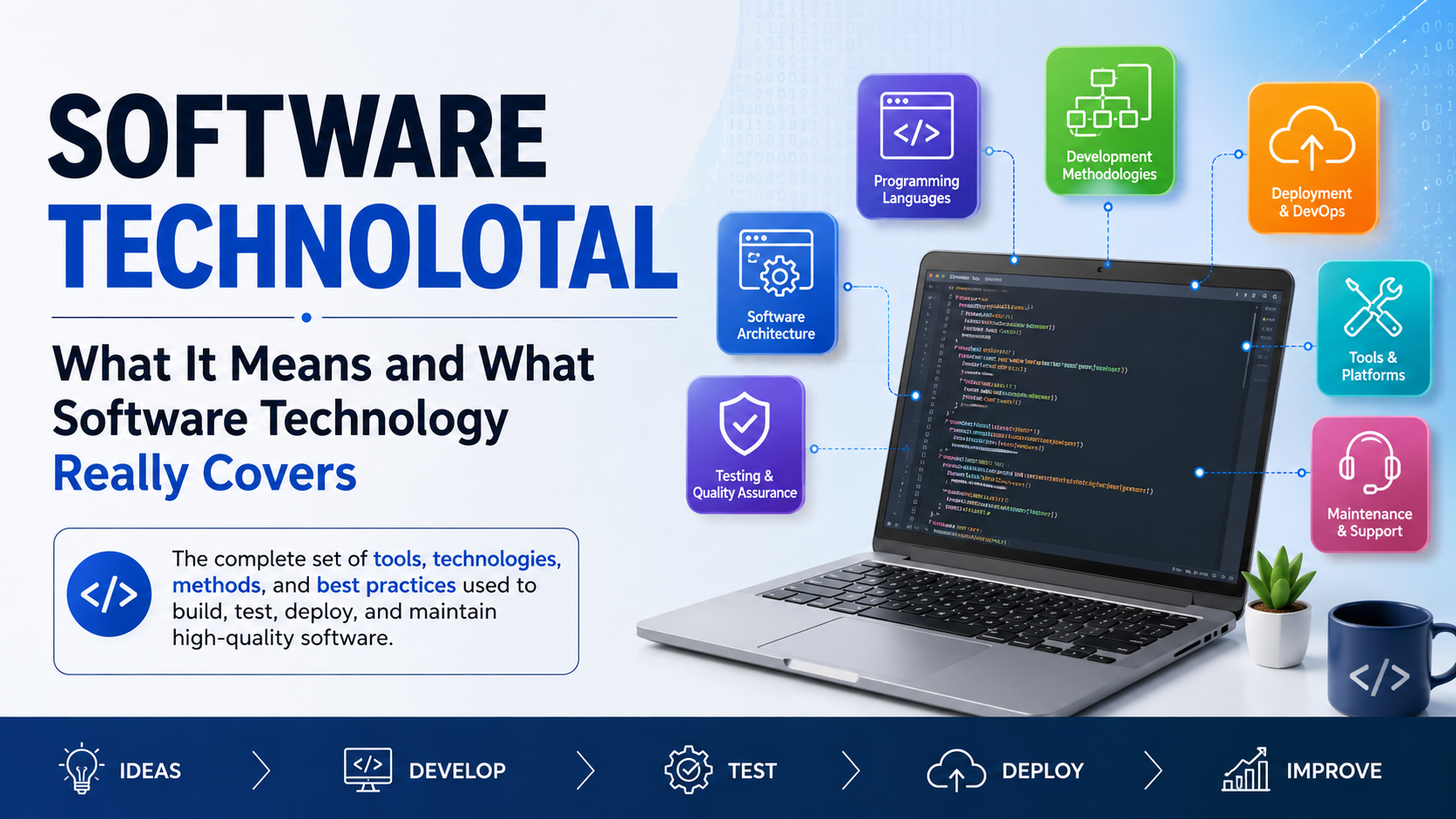
The phrase “software technolotal” is not an established technical term used by major standards organizations, software engineering references, or mainstream developer documentation. Based on current search results, it appears to be an informal search phrase that is sometimes used to refer broadly to software technology, or in some cases to content associated with the website Technolotal.org.
For readers searching for the meaning of the term, the most useful interpretation is therefore software technology: the collection of programming languages, development methods, software architectures, tools, platforms, testing practices, deployment systems, and maintenance techniques used to create and operate software.
This distinction matters because treating “Software Technolotal” as the name of a specific product, programming language, framework, or industry standard would be misleading. A broader and technically defensible interpretation connects the phrase to the established field of software technology, which covers both the technical artifacts and the knowledge and methods required to develop, operate, understand, and maintain software. A Software Engineering Institute review describes software technology in essentially this broad sense, including concepts, processes, methods, algorithms, and tools used throughout the software lifecycle.
What Is Software Technology?
Software technology is the practical technology used to build, run, test, secure, and maintain software.
Software itself is the collection of instructions and related data that tells a computer system what to do. Software technology is the much larger ecosystem surrounding that software.
For example, when someone opens an online banking application, many technologies may be involved at the same time:
- A programming language is used to implement application logic.
- A user interface displays information to the customer.
- APIs allow different systems to communicate.
- Databases store account and transaction information.
- Servers execute application code.
- Authentication systems verify the user’s identity.
- Encryption protects data in transit and, depending on the system, at rest.
- Monitoring systems detect failures and performance problems.
- Deployment tools deliver new versions of the software.
The user may only see a mobile screen or website, but software technology is working across the entire system behind that interface.
The Software Engineering Institute’s definition is useful because it goes beyond programming alone. It considers software technology to include the concepts, processes, methods, algorithms, and tools primarily intended to support the development, operation, and maintenance of software-intensive systems.
Is “Software Technolotal” an Official Technology Term?
No verified evidence indicates that “Software Technolotal” is a formal software engineering discipline or recognized technology standard.
Current web results use the phrase in different ways, but those usages are largely informal. Some pages explicitly describe it as an unofficial phrase associated with the broader concept of software technology.
There is also a website called Technolotal.org, which describes itself as a technology-focused publication covering technology discussions, updates, and digital topics. That does not, however, turn “Software Technolotal” into an established technical category.
This means readers should be careful with articles that present “Software Technolotal” as though it were a particular software platform, formal methodology, programming language, or standardized technology.
A technically safer interpretation is:
Software Technolotal = an informal search phrase most closely associated with software technology.
That interpretation allows the topic to be explained using established software engineering concepts rather than an invented technical definition.
What Does Software Technology Include?
Software technology covers far more than writing source code. A modern software system may combine several layers of technology, each serving a different purpose.
| Area | What it does | Common examples |
|---|---|---|
| Programming languages | Express application logic | Python, Java, JavaScript, C#, Go, Rust |
| Frameworks and libraries | Provide reusable functionality | React, .NET, Django, Spring |
| Databases | Store and retrieve information | PostgreSQL, MySQL, SQLite, MongoDB |
| APIs | Connect software systems | REST, GraphQL, RPC-based interfaces |
| Cloud platforms | Provide computing and infrastructure services | AWS, Azure, Google Cloud |
| DevOps tools | Automate building, testing, deployment, and operations | CI/CD systems, containers, orchestration |
| Testing technology | Detect defects and regressions | Unit, integration, system, security tests |
| Security technology | Reduce software and infrastructure risk | Authentication, encryption, vulnerability scanning |
| Observability | Monitor software behavior | Logs, metrics, traces |
| AI development tools | Assist development or provide intelligent features | LLMs, code assistants, ML frameworks |
The important point is that no single technology defines modern software development. Software products are usually combinations of many technologies working together.
How Software Technology Works in Practice
A useful way to understand software technology is to follow the path from an idea to a working application.
1. Requirements and Planning
Development normally begins with a problem that the software is intended to solve.
A company might want an application that allows customers to place orders, while a school might need software to manage student records.
At this stage, teams determine what the system needs to do, who will use it, what constraints exist, and what risks must be considered.
Requirements are important because writing technically correct code does not guarantee that the resulting software solves the right problem.
2. System and Software Design
The next stage determines how the application will be structured.
Developers and architects may choose:
- the programming languages,
- application architecture,
- database technology,
- external services,
- authentication methods,
- communication protocols,
- hosting environment,
- and deployment strategy.
For a small application, this structure may be relatively simple. A large enterprise platform can contain multiple applications, databases, queues, APIs, services, and infrastructure components.
3. Programming and Implementation
Developers then turn the design into executable software.
A programming language provides the rules used to express instructions in a form developers can write and computers can ultimately execute.
Modern software development rarely means writing everything from scratch. Developers commonly use libraries and frameworks, which provide prebuilt capabilities that can be incorporated into an application.
This can increase productivity, but it also introduces dependencies that must be maintained and secured.
4. Testing
Software needs to be tested before and after release.
Testing can occur at several levels. Unit tests examine individual pieces of functionality. Integration tests examine interactions between components. Higher-level testing checks whether the complete application behaves as expected.
Security testing is also important because ordinary functional testing does not necessarily reveal vulnerabilities.
5. Deployment
Once software is considered ready, it has to reach the environment where users will run it.
That environment might be:
- a personal computer,
- a mobile device,
- an on-premises server,
- a virtual machine,
- a container platform,
- or a cloud infrastructure environment.
Modern teams often automate parts of this process through continuous integration and continuous delivery or deployment, allowing software changes to move through repeatable build and test pipelines.
6. Operation and Maintenance
Software does not become finished simply because it has been released.
Real applications need:
Bug fixes, because unexpected defects appear in real-world use.
Security updates, because vulnerabilities can be discovered after release.
Compatibility changes, because operating systems, browsers, APIs, hardware, and dependencies evolve.
Performance improvements, because workloads can change as usage grows.
Feature development, because users and organizations require new capabilities.
This is why software engineering is not simply a coding activity. NIST defines a software development life cycle (SDLC) as a formal or informal methodology for designing, creating, and maintaining software.
Why Software Technology Matters
Software technology has become infrastructure for many parts of modern life.
Banking, telecommunications, logistics, healthcare systems, manufacturing, entertainment, education, retail, transportation, and government services all depend heavily on software.
The significance of software technology is not simply that software automates tasks. Modern software can coordinate entire systems.
For example, an online retailer may connect its website to inventory systems, payment processing, shipping services, customer databases, fraud detection, analytics, and notification platforms. Each component may be built using different technologies.
This creates a key characteristic of modern software:
Software systems are increasingly interconnected.
The result is greater flexibility and functionality, but also more dependencies and more opportunities for failure.
Software Technology and Cloud Computing
One of the biggest changes in software development has been the shift toward software that depends on networked infrastructure and cloud services.
Instead of installing every piece of infrastructure on company-owned physical servers, organizations can use computing, storage, databases, networking, and other services provided by cloud platforms.
This can make it easier to scale systems and provision infrastructure, although cloud computing does not automatically make software simpler or cheaper.
A modern cloud application might use:
- A web or mobile client.
- An application backend.
- One or more databases.
- Object or file storage.
- APIs and third-party services.
- Authentication services.
- Monitoring and logging.
- Automated deployment infrastructure.
The software technology is therefore distributed across multiple layers rather than concentrated in one program.
Software Technology and APIs
An API, or application programming interface, is a defined way for software components to communicate.
Suppose a shopping application needs payment processing. Instead of implementing an entire payment network itself, it may call an external payment API.
The application sends a request, the remote service processes it, and the result is returned.
APIs are one reason modern software can be assembled from many independent services.
However, APIs also create dependencies. If an external API changes, becomes unavailable, introduces stricter authentication, or removes a feature, software depending on it may need to change.
Software Technology and Databases
Most useful applications need to store information.
A database provides a structured system for storing and retrieving that information.
A customer-management application, for example, might store customer names, account records, transactions, preferences, and activity history.
Different database technologies are designed for different requirements. Relational systems organize data around structured tables and relationships, while other database approaches may prioritize different data models or operational requirements.
Choosing a database is therefore not simply a popularity contest. The right choice depends on data structure, consistency requirements, scale, query patterns, operational needs, and application architecture.
Software Technology and Cybersecurity
Security is now an essential part of software technology rather than something that can safely be added at the very end.
A software vulnerability is a weakness that can potentially be exploited to compromise confidentiality, integrity, availability, or another security property.
NIST’s Secure Software Development Framework (SSDF) recommends integrating secure development practices into software development rather than treating security as a separate afterthought. NIST organizes the framework into four major practice groups: preparing the organization, protecting software, producing well-secured software, and responding to vulnerabilities.
NIST’s current SSDF publication list also shows that SP 800-218 Revision 1 / SSDF 1.2 was released as an initial public draft in December 2025, showing that secure software development guidance continues to evolve.
For organizations, this has a practical implication: security needs to be considered during architecture, coding, dependency management, testing, release, and maintenance.
The Role of Artificial Intelligence in Modern Software Technology
Artificial intelligence is now influencing software development itself, not just the applications developers build.
AI-powered coding tools can assist with generating code, explaining existing code, writing documentation, answering technical questions, and supporting debugging.
The 2025 Stack Overflow Developer Survey reported that 84% of respondents were using or planning to use AI tools in their development process, while 51% of professional developers said they used AI tools daily.
However, adoption does not mean AI-generated output should be accepted without verification.
The same survey reported that 46% of respondents distrusted the accuracy of AI-tool output, compared with 33% who trusted it, and identified “almost right, but not quite” results as a major frustration.
That distinction is important.
AI can help developers produce software faster, but faster code generation is not the same thing as correct software. Human review, testing, security analysis, and architectural judgment remain necessary.
Are AI Agents Replacing Traditional Software Development?
Not based on current developer adoption data.
The 2025 Stack Overflow survey found that AI agents were not yet mainstream: 52% of respondents either did not use agents or used simpler AI tools, while 38% said they had no plans to adopt agents.
This suggests a more realistic view of AI in software technology.
Rather than assuming software engineers will disappear, current evidence points toward workflows in which developers increasingly combine conventional programming with AI-assisted development.
An AI assistant may generate a function, but developers still need to determine:
- whether the function solves the correct problem,
- whether it handles edge cases,
- whether it introduces security issues,
- whether it fits the system architecture,
- and whether tests adequately verify its behavior.
The development process is changing, but engineering responsibility remains.
Programming Languages Still Matter
Despite the growth of AI-assisted development, programming languages remain fundamental because software still has to be expressed in precise, executable form.
Different languages are commonly associated with different types of development.
Python is widely used across backend development, automation, scientific computing, data work, and AI.
JavaScript and TypeScript are central to much of modern web development.
Java and C# are widely used for enterprise and application development.
C and C++ remain important in systems programming and performance-sensitive software.
Go and Rust are prominent in areas such as infrastructure and systems software.
The correct programming language depends on the actual requirements rather than trends alone.
The 2025 Stack Overflow Developer Survey reported continued growth in Python adoption, linking its use to AI, data science, and backend development.
Software Development Approaches
Software technology also includes the methods teams use to organize development.
Waterfall
Waterfall follows a relatively sequential approach in which requirements, design, implementation, testing, and deployment are treated as distinct stages.
It can be appropriate where requirements are relatively stable and extensive up-front planning is valuable.
Agile
Agile approaches emphasize incremental development, feedback, collaboration, and adapting to changing requirements.
Instead of trying to define everything before development begins, teams often deliver software in smaller increments.
DevOps
DevOps brings development and operations practices closer together.
Its goal is not simply to buy automation tools. It involves improving collaboration, feedback loops, infrastructure management, testing, deployment, monitoring, and operational reliability.
Modern software technology often combines Agile development with DevOps practices and automated delivery pipelines.

What Are the Benefits of Modern Software Technology?
The advantages depend on the technologies selected and how effectively they are implemented.
Automation
Software can perform repetitive tasks much faster and more consistently than manual processes.
Scalability
Cloud infrastructure, distributed architectures, caching, databases, and other technologies can allow applications to support changing workloads.
Faster Development
Frameworks, reusable libraries, automation, open-source software, and increasingly AI-assisted development can reduce the amount of repetitive work.
Integration
APIs and standardized interfaces allow separate systems to communicate.
Continuous Improvement
Modern deployment pipelines allow organizations to release fixes and improvements without waiting for a completely new product cycle.
What Are the Disadvantages and Risks?
Software technology also introduces significant challenges.
Complexity
A sophisticated application can depend on hundreds or thousands of libraries, services, APIs, infrastructure components, and configuration settings.
More components can mean more failure points.
Security Risk
Every component can potentially introduce vulnerabilities or misconfigurations. This is one reason secure development practices must be incorporated throughout the software lifecycle.
Dependency Problems
A project may depend on an external library or service that changes, becomes unsupported, or develops a security vulnerability.
Maintenance Costs
Software requires continuing engineering work. A program that works today may stop working correctly after operating-system changes, dependency updates, infrastructure changes, or new security requirements.
Rapid Change
The software industry evolves quickly. A tool that is popular today may become less important later.
This is particularly relevant to AI development, where frameworks, models, APIs, and development tools are changing rapidly.
How to Evaluate a Software Technology
When choosing a technology, popularity should not be the only criterion.
A better evaluation considers:
| Question | Why it matters |
|---|---|
| What problem does it solve? | Prevents unnecessary technology choices |
| Is it mature enough? | Reduces operational and maintenance risk |
| Does it fit the architecture? | Avoids integration problems |
| How secure is it? | Helps reduce vulnerability exposure |
| Is it actively maintained? | Reduces long-term dependency risk |
| Does the team understand it? | Affects development and support costs |
| Can it scale appropriately? | Prevents future infrastructure problems |
| What are its dependencies? | Reveals hidden operational risk |
| How easy is it to test? | Improves reliability |
| What happens if it is abandoned? | Helps with long-term planning |
The best technical choice is often the one that fits the project’s real requirements, not the one receiving the most attention online.
A Simple Example of Software Technology in Everyday Life
Consider a food-delivery application.
When a customer places an order, the process may involve many software technologies:
Mobile application: displays restaurants and accepts the customer’s actions.
Backend services: process business logic such as orders and accounts.
Database: stores customer, restaurant, and order data.
Payment service: processes financial transactions.
Maps or location services: provide geographic information.
Notification system: sends order updates.
Authentication: verifies the customer.
Monitoring: detects failures and unusual behavior.
Cloud infrastructure: provides the servers and other resources required to run the platform.
From the user’s perspective, it may feel like one application.
Technically, it can be a network of interacting software systems.
That is one of the most important ideas for understanding modern software technology.
What Software Technology Looks Like in 2026
The software industry is currently moving toward increasingly AI-assisted development, cloud-connected systems, automation, stronger security practices, and highly integrated development workflows.
AI is particularly visible, but current evidence suggests that organizations are not simply replacing conventional development methods with autonomous systems. Developers are experimenting with AI tools while continuing to rely on established programming environments, testing practices, version control, documentation, and human review.
Security is also becoming more integrated with software engineering. NIST’s ongoing work on the SSDF, including the draft 1.2 revision and AI-specific guidance, reflects the growing need to account for security across modern software development workflows.
The most important long-term trend is therefore not a single framework or programming language.
It is the movement toward software development as an integrated engineering system, combining code, infrastructure, security, automation, data, AI, testing, deployment, and monitoring.
Software Technolotal vs. Software Technology
Because the target phrase is unusual, the distinction is worth making explicit.
| Term | Status | Practical meaning |
|---|---|---|
| Software Technolotal | Informal/unofficial phrase | Often appears to refer broadly to software technology or related web content |
| Software Technology | Established technical concept | Technologies, methods, tools, and knowledge used to develop and operate software |
| Software Engineering | Established discipline | Systematic engineering practices for software development, operation, and maintenance |
| Software Development Life Cycle (SDLC) | Established concept | Methodology or process for designing, creating, and maintaining software |
| Software Development | Established activity | The practical work of designing, implementing, testing, deploying, and maintaining software |
This distinction is especially important for anyone researching the phrase for education, software purchasing, development planning, or technical documentation.
Frequently Asked Questions
What does software technolotal mean?
“Software Technolotal” does not appear to be a formal software engineering term. It is better interpreted as an informal search phrase referring to software technology, although it may also be associated with the Technolotal website.
Is Software Technolotal a software program?
There is no reliable evidence that “Software Technolotal” is the official name of a recognized software program, framework, programming language, or standard technology.
What is software technology in simple words?
Software technology is everything used to create, run, secure, test, deploy, and maintain software. It includes programming languages, frameworks, databases, APIs, cloud infrastructure, development tools, testing systems, and security technologies.
Is software technology the same as software engineering?
No. They overlap, but they are not identical. Software technology describes the technologies and technical methods used in software, while software engineering is the broader engineering discipline concerned with systematically developing, operating, and maintaining software.
Why is software technology important?
Modern organizations depend on software for communication, commerce, data processing, automation, infrastructure, customer services, and internal operations. Software technology provides the technical foundation for creating and maintaining those systems.
Is AI part of modern software technology?
Yes. AI is increasingly part of both the software-development process and the software products being built. Current developer survey data shows substantial adoption of AI-assisted development tools, although concerns about accuracy and verification remain significant.
What should beginners learn first?
A practical starting point is to understand basic programming, data structures, databases, APIs, software testing, version control, operating systems, networking fundamentals, and security concepts. Once those foundations are clear, frameworks and specialized tools become much easier to understand.
Conclusion
“Software Technolotal” is best understood as an informal and ambiguous phrase rather than a recognized technical discipline. The established field behind the phrase is software technology: the broad ecosystem of tools, programming techniques, architectures, processes, infrastructure, security practices, and engineering knowledge used to build and operate software.
Understanding that distinction prevents confusion. Instead of searching for a supposedly specific “Software Technolotal” technology, readers can look at the real components that make modern software work: programming languages, frameworks, databases, APIs, cloud platforms, testing, DevOps, cybersecurity, automation, and increasingly AI-assisted development.
The broader field continues to evolve, but the underlying principle remains the same: successful software is not just code. It is the combination of people, processes, technologies, architecture, security, testing, and ongoing maintenance required to turn an idea into a reliable working system.
