



A Valheim materials calculator helps you work out how many resources you need before crafting equipment, upgrading stations, cooking, brewing, or constructing a large base. Instead of checking individual recipes and manually adding wood, stone, metals, hides, fibers, and other components, a calculator can turn your planned items into a consolidated resource list.
This is especially useful in Valheim, where an apparently simple crafting goal can involve several layers of materials. You may need a processed material first, which itself requires another resource and a particular crafting station. A useful calculator handles those dependencies rather than showing only the ingredients listed on the final item.
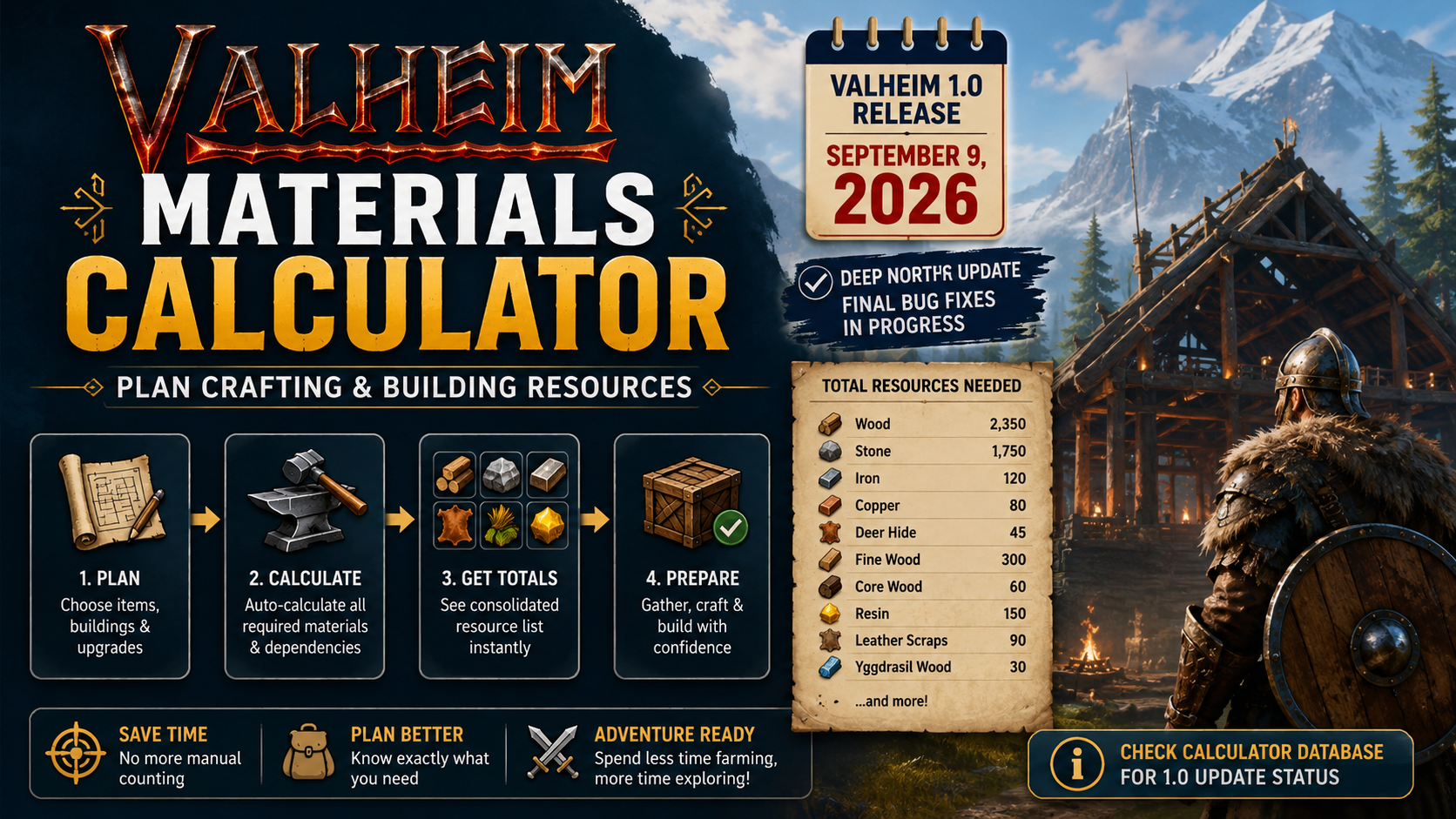
There is also an important timing issue right now. Valheim 1.0 is scheduled for September 9, 2026, including the Deep North, while Iron Gate says the team is currently fixing final bugs ahead of release. That means calculator databases are worth checking for update status around the 1.0 launch.
What Is a Valheim Materials Calculator?
A Valheim materials calculator is an online planning tool that converts your desired crafting or building projects into the resources required to complete them.
For example, instead of separately asking:
How much material does this weapon require?
and then:
How much material do I need for the upgrade?
and then:
What do I need for the crafting station?
a calculator can organize those requirements into one project.
The basic idea is simple:
Items you want → recipes → intermediate materials → raw resources
A good calculator may also account for crafting stations, upgrades, item levels, food, meads, or building pieces.
This matters because Valheim’s crafting system is hierarchical. A final item can depend on an intermediate material, and that intermediate material can depend on another raw resource or processing step.
Why Use a Materials Calculator in Valheim?
The biggest advantage is that it removes repetitive manual arithmetic.
Suppose you are preparing for a new expedition and want several pieces of equipment. Without a calculator, you might open a recipe for each item, write down the requirements, remember which ingredients overlap, and then calculate the totals yourself.
That becomes increasingly difficult as a project grows.
A calculator can help answer questions such as:
- How much wood do I need?
- How much metal must I gather?
- What resources are required for several pieces of equipment?
- Which intermediate materials need to be produced?
- What crafting structures do I need?
- How much have I already collected?
- Which resources are still missing?
- What should I gather before returning to base?
For building projects, this becomes even more valuable because a large construction can contain hundreds or thousands of individual pieces.
How a Valheim Resource Calculator Works
A materials calculator generally follows the game’s recipe relationships.
Imagine you select three different items. The calculator first reads the recipe for each one and creates a combined requirement list.
It then checks whether any materials appear in multiple recipes.
Instead of displaying:
Item A: Wood 20
Item B: Wood 30
Item C: Wood 15
a consolidated calculator can show:
Total Wood: 65
The same principle can be applied to more complicated crafting chains.
Raw materials and processed materials
This distinction is particularly important.
A raw material is something you collect directly from the world or obtain from creatures, objects, or other sources. A processed material is created by transforming another resource.
For planning purposes, there are therefore two useful ways to display the requirement:
Crafted requirement: the immediate materials consumed by the recipe.
Raw-resource requirement: the underlying resources you must ultimately acquire.
For example, a calculator may tell you that you need an intermediate metal component while also expanding that requirement to the corresponding ore or other source material.
That makes the result much more useful for an actual gathering trip.
Valheim Materials Are Not All the Same
One reason manual calculation can become confusing is that Valheim contains many different types of materials.
The current Valheim.tools database, for example, lists hundreds of materials and components, covering metals, hides, fibers, crafting ingredients and other categories. It also separates material information by biome tier.
Common resource categories include:
| Material category | Examples of what it may represent |
|---|---|
| Basic resources | Wood, stone, flint and similar early-game resources |
| Metals | Copper, tin, bronze, iron, silver and later metals |
| Creature materials | Hides, trophies, teeth, bones and other drops |
| Plant resources | Seeds, fibers, thistle and other gathered materials |
| Advanced components | Materials introduced in later progression stages |
| Processing ingredients | Resources used to transform materials at crafting stations |
| Building materials | Resources consumed by structural and decorative pieces |
A useful calculator should distinguish these resources rather than reducing everything to one generic “material” number.
Crafting Calculator vs. Materials Calculator
The terms Valheim crafting calculator, resource calculator, and materials calculator are often used interchangeably, but there is a useful distinction.
A crafting calculator normally focuses on what is required to create selected items.
A materials calculator emphasizes the accumulated resource requirements.
A building calculator focuses specifically on construction pieces and their costs.
In practice, many modern Valheim tools combine all three functions.
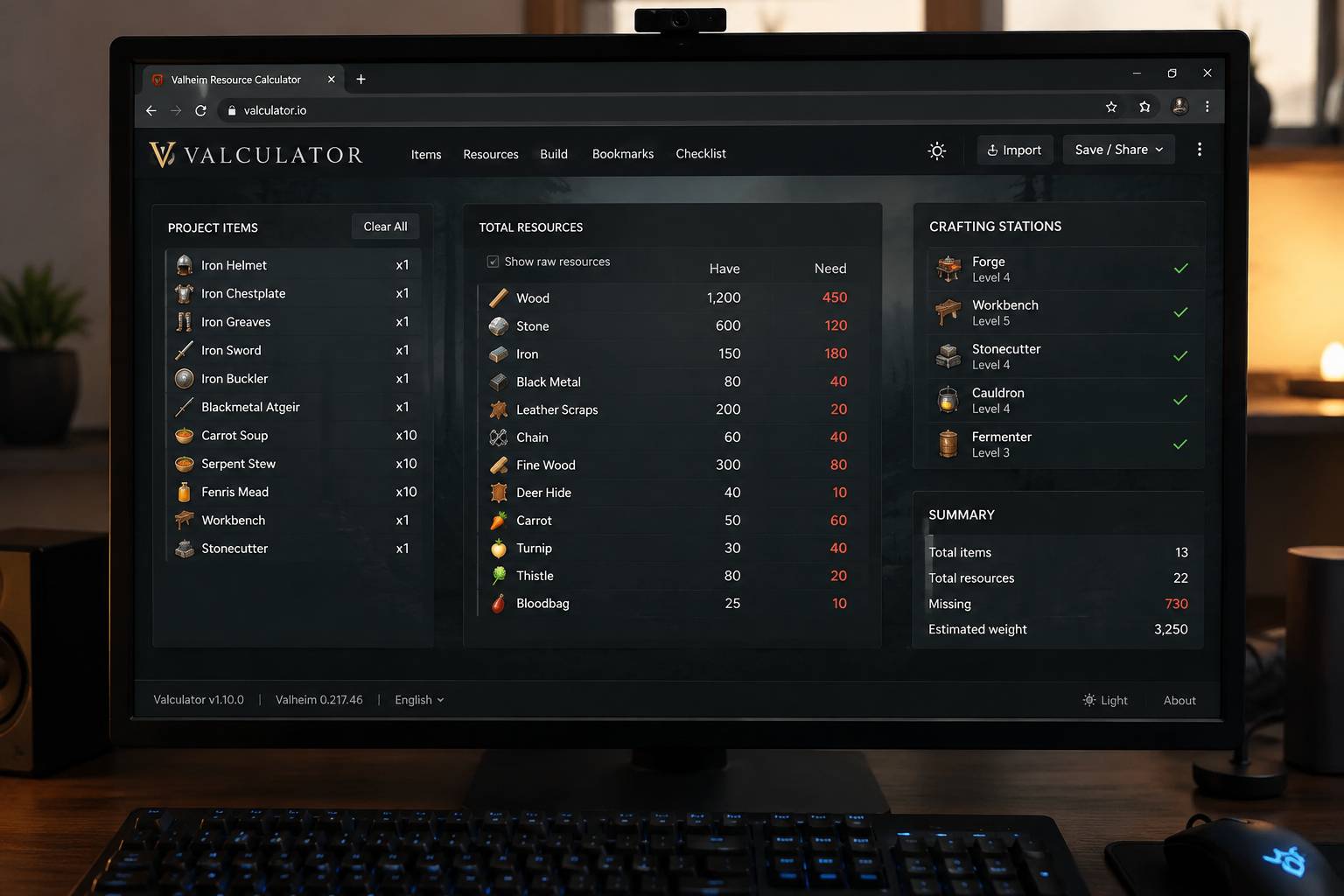
For example, Valculator describes itself as a free Valheim resource calculator and says its features grew from a spreadsheet for calculating resources needed for equipment. Its current interface provides item searching and selection, while its broader project includes crafting structures and collection checklists.
Valheim.tools likewise provides a database containing building pieces, material costs and crafting information, alongside an interactive crafting calculator.
How to Use a Valheim Materials Calculator
Using one effectively is more than entering a single item.
1. Decide what you actually want to accomplish
Start with the project, not the resource.
For example:
“I want to prepare equipment for my next biome.”
or:
“I want to build a new main hall.”
or:
“I want to upgrade my crafting setup.”
This prevents you from gathering large amounts of resources that you do not immediately need.
2. Select every planned item
Add the weapons, armor, tools, upgrades, food, meads, or building pieces that belong to the project.
The more complete your selection is, the more useful the final total becomes.
3. Let the calculator combine overlapping requirements
The important part is consolidation.
If five selected recipes use the same resource, you should ideally see one total instead of five separate numbers.
This gives you a genuine shopping list for Valheim rather than a collection of disconnected recipes.
4. Subtract resources you already own
Some calculators provide collection or checklist functions.
Valculator, for example, includes functionality for tracking items and resources you have collected.
This changes the calculation from:
Total required
to:
Total required − already owned = still needed
That is much more practical when preparing for a long crafting session.
5. Check the intermediate requirements
Do not stop at the final number.
Look at whether you need additional processing, crafting stations, upgrades, or intermediate components.
This is one of the major reasons a dedicated calculator is preferable to simply searching for individual Valheim recipes.
Building Projects Need a Different Kind of Calculation
A materials calculator becomes particularly useful when planning a Valheim base.
A large building can contain many repeated structural pieces. Individually checking the resource cost of every floor tile, wall, roof component, beam, door, window and decorative piece would be tedious.
A building-oriented calculator allows you to estimate the resource cost of the entire design.
Valheim.tools currently maintains a building database covering hundreds of build pieces, including material costs.
Why building calculations are harder
A building may contain:
- repeated floor sections
- structural supports
- walls
- roofs
- stairs
- doors
- windows
- decorative pieces
- furniture
- lighting
- comfort-related objects
- crafting stations
The challenge is therefore not simply knowing what one piece costs. It is calculating hundreds of repeated choices as one project.
For a major construction, even a small mistake in your estimate can mean another long gathering trip.
Workbench and Forge Requirements Matter Too
Materials are only one part of the preparation process.
Some equipment requires access to the appropriate crafting structure and, in certain cases, the appropriate upgrade level.
For example, the Workbench can be upgraded through nearby structures, while the Forge has its own upgrade requirements.
A strong calculator should therefore answer two separate questions:
“What resources do I need?”
and
“What crafting infrastructure do I need?”
This distinction is easy to overlook.
You can have every ingredient in your inventory and still be unable to craft the desired item because the required station or upgrade is missing.
The Most Useful Feature: Recursive Material Calculation
The most valuable feature in an advanced Valheim calculator is often called a material tree, recipe tree, or recursive calculation.
“Recursive” simply means the tool keeps following a recipe backwards.
Suppose:
Final item → intermediate component → raw material
The calculator follows every link until it reaches resources you actually need to collect.
This is much more useful than displaying only the immediate recipe.
A current community project called Forgeheim describes its Crafter as a revised Valculator-style tool that can show the full material tree down to raw resources, subtract resources you already own, and let users track gathering progress.
That illustrates exactly why material-tree calculations are useful for serious preparation.
Popular Valheim Calculator Options
There is no single official “Valheim Materials Calculator” published by Iron Gate. The commonly used calculators are community-made tools, so their accuracy depends on how quickly their databases are updated as the game changes.
Valculator
Valculator is one of the established community resource-planning tools.
Its creator, Studio Helga, explains that the project began as a simple spreadsheet for calculating materials and grew into an interactive Valheim companion application.
The current interface provides searchable items and filtering by categories such as item type and crafting-related information.
Its major advantage is that it is specifically designed around resource planning and crafting preparation, rather than functioning only as a static wiki.
Valheim.tools
Valheim.tools is a broader Valheim database rather than only a calculator.
Its database currently covers items, creatures, materials, building pieces, food, crafting information and other game data. Its site says the data is datamined from the game, and it includes an interactive crafting calculator.
This can be useful when you want the calculator and the underlying item information in the same place.
However, it remains an unofficial fan database, so it should not be confused with an official Iron Gate reference.
Community forks and newer tools
Valheim’s calculator ecosystem continues to change.
For example, a community project called Forgeheim was announced in July 2026 as a Valculator-derived tool with an expanded crafting checklist, material-tree calculation, collection tracking and sharing features.
This is a useful reminder that there is no permanent “best” calculator. A newer tool may have better support for recent content, while an established tool may have a larger or more mature database.
Why Calculator Results Can Be Wrong
A calculator is only as reliable as its underlying database.
This matters particularly for Valheim because the game is still changing immediately before its 1.0 release.
Iron Gate’s official 1.0 FAQ says Valheim 1.0 launches on September 9, 2026, and the release includes the Deep North.
The official site also states that the developers were still working on final bugs and preparations in August 2026.
Consequently, a calculator that works correctly today may need a database update after the 1.0 release.
Common reasons for discrepancies
A calculator may differ from the game because:
The calculator database is outdated. A recipe may have changed after the tool’s data was collected.
The game version is different. Public-test and release data can differ.
A recently added item is missing. New content takes time to be incorporated into unofficial databases.
A recipe is interpreted differently. Some tools may display immediate crafting requirements while others expand them into raw-resource totals.
The tool has an incorrect entry. Community databases can contain errors.
For important crafting projects, the safest approach is to use a calculator for planning and then verify the final recipe in the current game.
Why the September 2026 1.0 Release Matters
This is particularly important for anyone searching for a Valheim materials calculator right now.
As of September 1, 2026, Valheim is approaching its first full 1.0 release. Iron Gate has confirmed that the Deep North is part of that release, and the developer recommends starting a new playthrough for the best 1.0 experience. Existing saves will remain available, although unexplored areas are important for new biome generation.
Iron Gate also says that Valheim will continue receiving bug fixes and quality-of-life improvements after 1.0, although the duration of future updates and whether additional content will be added are not yet confirmed.
For calculator users, that means version awareness is becoming more important.
A calculator should ideally identify what game data it currently represents. After 1.0 launches, check that the calculator has been updated before relying on it for newly introduced recipes, materials, enemies, or building pieces.
How to Make Your Own Simple Materials Calculation
You do not necessarily need a specialized website for a small project.
The basic calculation is:
Total required material = sum of that material across all selected recipes
Then:
Remaining material = total required − material already owned
For multiple crafting levels, the calculation becomes:
Raw resources required = final recipe requirements + all resources needed for intermediate materials
This is essentially what a more sophisticated calculator automates.
For example, rather than manually recording every recipe in a notebook, you can create a spreadsheet with columns for:
| Item | Quantity | Wood | Stone | Metal | Creature materials | Other |
|---|---|---|---|---|---|---|
| Planned item A | 1 | — | — | — | — | — |
| Planned item B | 1 | — | — | — | — | — |
| Planned item C | 1 | — | — | — | — | — |
| Total | SUM | SUM | SUM | SUM | SUM |
This works, but an online calculator is generally easier once your project becomes large or includes multi-step crafting.
Valheim Materials Calculator for Multiplayer
A calculator is also useful for co-op servers.
Instead of five players independently gathering whatever resources they think are necessary, the group can divide a consolidated resource list.
For example:
Player 1: wood and stone
Player 2: metal gathering
Player 3: creature materials
Player 4: food ingredients
Player 5: crafting-station preparation
The advantage is coordination.
Everyone is working toward the same total requirement, reducing duplicated effort.
Some newer community tools also provide shared or shareable lists, which can make this process easier for groups.
What Makes a Good Valheim Materials Calculator?
When choosing a calculator, look beyond whether it has a large list of items.
The most useful features are:
| Feature | Why it matters |
|---|---|
| Recipe database | Provides the underlying crafting requirements |
| Material totals | Combines resources across multiple selected items |
| Recursive recipes | Shows what is needed to produce intermediate materials |
| Building calculations | Useful for large bases |
| Crafting-station requirements | Prevents infrastructure-related surprises |
| Inventory subtraction | Shows what you still need to gather |
| Checklist | Helps track gathering progress |
| Search and filters | Makes large databases easier to use |
| Version updates | Reduces the risk of outdated recipes |
| Shareable lists | Useful for multiplayer planning |
The database’s freshness is arguably more important than the number of interface features.
A beautiful calculator with old recipes is less useful than a simple tool whose data matches the current game.
Tips for Getting Better Results
Use a calculator before a resource-gathering trip rather than after you have already started collecting.
For a small project, calculate exactly what you need. For a large project, consider adding a modest buffer for unexpected crafting, replacement equipment, repairs, or design changes—but treat that as your own planning margin rather than pretending it is part of the game’s official recipe.
Also separate what you need to craft from what you need to carry.
Your calculator might tell you that a project requires a certain amount of material, but your character can still be limited by inventory slots, weight, transportation, portals, carts, ships, or where the resource can be obtained.
The calculation answers:
“How much do I need?”
Your logistics plan answers:
“How am I going to get it home?”
That distinction becomes increasingly important when collecting heavy resources.
Can a Valheim Materials Calculator Include Everything?
Not necessarily.
A calculator can calculate recipes, but it cannot perfectly predict every player-specific decision.
For example, a calculator generally cannot know:
- how much material you already consumed,
- how much you will lose or leave behind,
- what construction changes you will make,
- which alternative items you decide to use,
- what resources are available in your current base area,
- or how much extra material you personally want to keep in reserve.
It should therefore be treated as a planning assistant, not as an absolute guarantee.
FAQ
What is the best Valheim materials calculator?
There is no officially designated best calculator. Valculator is a long-running community resource calculator, while Valheim.tools combines a large game database with crafting and material information. Newer community tools may add additional planning features.
Is there an official Valheim materials calculator?
Iron Gate provides the game itself and official documentation/news, but the commonly available online materials calculators are community-made rather than official Iron Gate tools.
Can a Valheim calculator calculate building materials?
Yes. Some tools include building-piece costs and can be used to plan construction projects. Valheim.tools currently maintains a dedicated building database with material costs.
Can a calculator subtract materials I already have?
Some can. Valculator provides collection/checklist functionality, and newer community tools have also implemented inventory subtraction and gathering tracking.
Will Valheim calculators work with version 1.0?
They should only be considered reliable for 1.0 content once their databases have been updated and verified against the release. Valheim 1.0 launches September 9, 2026, so calculator support for the new content is an important consideration immediately after launch.
Should I trust a calculator more than the recipe shown in Valheim?
No. A calculator is excellent for organizing information, but the current in-game recipe should be the final authority when there is a discrepancy.
Final Takeaway
A Valheim materials calculator is essentially a resource-planning system for turning a crafting or building goal into a practical gathering list. Its greatest value comes from combining several recipes, expanding intermediate materials, tracking what you already own, and showing the resources and crafting infrastructure still required.
For simple projects, you can calculate requirements manually. For large equipment plans, crafting upgrades, multiplayer preparation, or major base builds, an interactive calculator can save considerable time and reduce unnecessary gathering trips.
The most important consideration in September 2026 is data freshness. Valheim is about to transition to 1.0 on September 9, 2026, with the Deep North completing the game’s major biome lineup. As that update arrives, make sure the calculator you use has caught up with the released recipes and building data rather than assuming an older database is automatically correct.
A good workflow is therefore simple: choose your project, calculate the complete material tree, subtract what you already have, check the required crafting stations, gather the remaining resources, and verify important recipes in the current game version before crafting.
Also Read: OpenICU Software for Critical Care Dashboards | What It Is and How It Works

1 Comment
Pingback: Does Monada.ai Have a Blog? Yes | Here’s What You’ll Find