


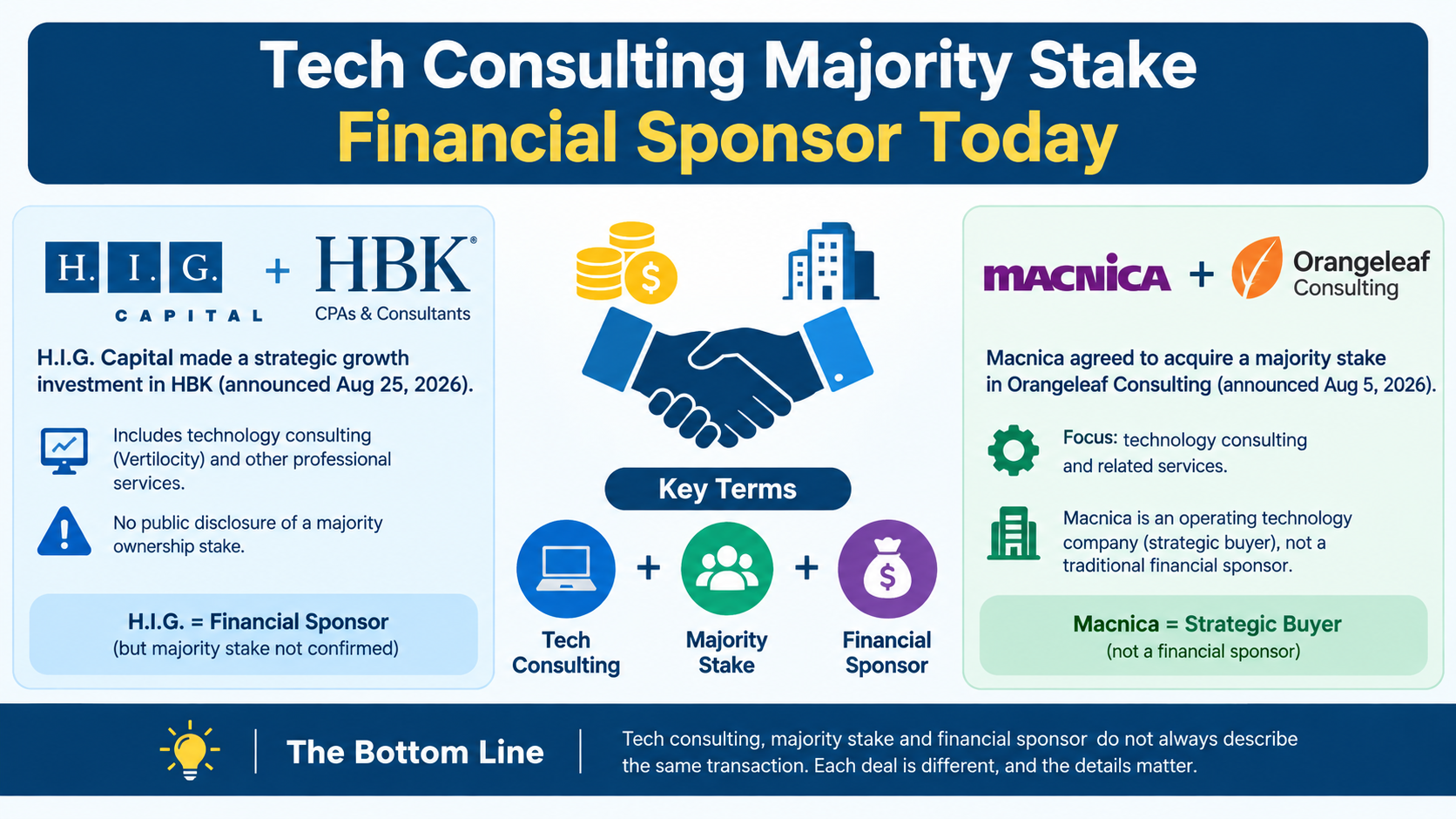
As of September, 2026, the clearest current example matching the search for a tech consulting majority stake backed by a financial sponsor is H.I.G. Capital’s strategic growth investment in HBK, announced on August 25, 2026. HBK is an integrated professional-services firm whose businesses include technology consulting through Vertilocity, alongside accounting, tax, audit, consulting, and wealth management. However, H.I.G. has not publicly disclosed that it acquired a majority ownership stake, so it would be inaccurate to describe the transaction as a confirmed majority acquisition.
There is also a very recent confirmed majority-stake technology consulting transaction: Macnica agreed to acquire a majority stake in Orangeleaf Consulting on August 5, 2026. But Macnica is an operating technology company and therefore a strategic buyer, not a traditional financial sponsor such as a private-equity firm.
That distinction is important because the three terms in the search — tech consulting, majority stake, and financial sponsor — do not all describe the same transaction.
What “Tech Consulting Majority Stake Financial Sponsor Today” Means
The search phrase appears to be looking for a current deal involving a technology consulting company, a majority ownership investment, and a financial sponsor.
A majority stake generally means an investor owns more than 50% of a company. Majority ownership can give the investor substantial control over important corporate decisions, although the precise rights depend on the transaction documents.
A financial sponsor is typically an investment firm such as a private-equity firm that invests capital in businesses with the objective of generating a financial return. This is different from a strategic buyer, which purchases or invests in a company partly because the target’s technology, customers, geographic presence, talent, or capabilities complement its existing operating business.
That distinction produces an important result when looking at the latest technology-consulting transactions: the strongest current financial-sponsor match and the strongest current majority-stake match are different deals.
H.I.G. Capital and HBK: The Key Financial-Sponsor Deal
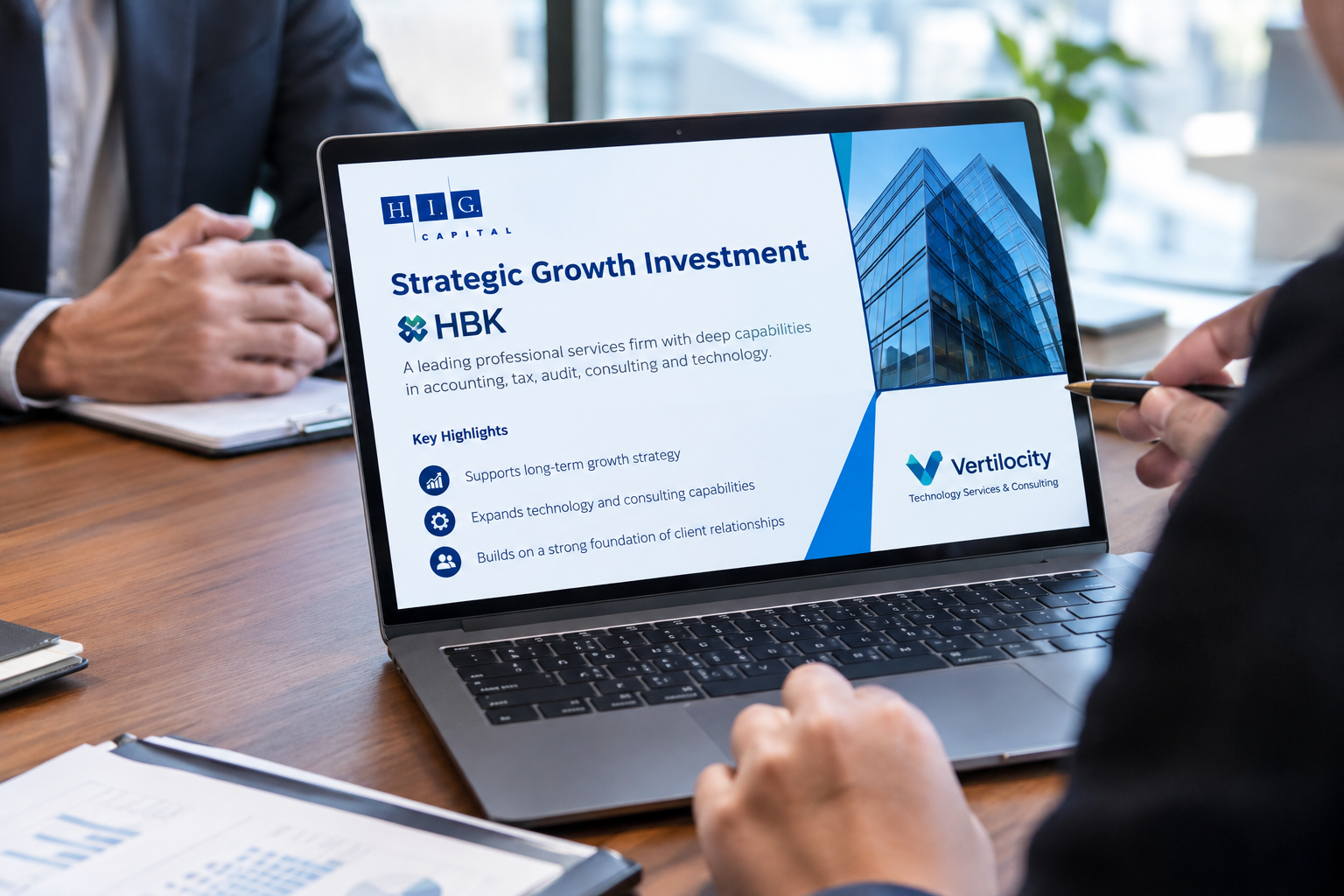
On August 25, 2026, H.I.G. Capital announced that an affiliate had made a strategic growth investment in HBK. H.I.G. described the transaction as its first institutional partnership with HBK. HBK said its partners would continue to lead the firm while receiving additional resources and capabilities to support future growth.
The transaction is particularly relevant to technology consulting because HBK’s organization includes Vertilocity, a technology services and consulting business. Vertilocity provides services including managed IT, cloud services, IT hardware procurement, unified communications, and virtual CIO services.
H.I.G. is clearly the type of investor that qualifies as a financial sponsor. Its announcement describes the firm as a global alternative investment firm, while H.I.G.’s current corporate information states that it has approximately $75 billion of capital under management.
Did H.I.G. Buy a Majority Stake in HBK?
That has not been publicly confirmed.
This is the most important factual qualification surrounding the search keyword. H.I.G. and HBK have publicly described the transaction as a strategic growth investment, but the announcements reviewed do not state that H.I.G. acquired more than 50% of HBK.
Neither announcement publicly specifies the exact percentage of ownership acquired, the transaction value, HBK’s valuation, or a detailed financing structure. Consequently, it would be misleading to turn the deal into a confirmed majority-stake acquisition simply because the phrase appears in search queries about the transaction.
There is another important timing point: the transaction has not yet been announced as closed. H.I.G. and HBK said it is expected to close in the fourth quarter of 2026, subject to customary closing conditions and required regulatory approvals. As of September 7, 2026, that means the announced investment should be treated as a pending transaction rather than a completed acquisition.
| Deal | Investor | Majority stake confirmed? | Investor type | Current status |
|---|---|---|---|---|
| HBK / H.I.G. Capital | H.I.G. Capital | No public percentage disclosed | Financial sponsor | Expected to close Q4 2026 |
| Orangeleaf Consulting / Macnica | Macnica | Yes | Strategic technology buyer | Majority acquisition announced |
| IM Corporation / Fidel | Fidel Technologies KK | Yes | Strategic operating company | Acquisition completed |
Why the HBK Deal Matters to Technology Consulting
The HBK transaction illustrates how technology consulting can be embedded inside a broader professional-services platform rather than existing as a standalone IT consultancy.
Vertilocity operates across areas such as managed services, cloud, cybersecurity-related technology services, IT infrastructure, communications, and technology strategy. For an investor, this can create a business model that combines recurring technology services with consulting and advisory work.
The important point is not that H.I.G. is necessarily buying a pure-play technology consulting firm. HBK is a broader professional-services organization, and the investment covers the wider platform, including its technology business. That makes it a useful example of financial-sponsor interest in technology-enabled professional services, but not evidence of a newly disclosed majority takeover of a standalone tech consultancy.
Macnica and Orangeleaf: The Confirmed Majority-Stake Example
For readers specifically searching for a confirmed majority stake in a technology consulting business, Orangeleaf Consulting provides a clearer match.
On August 5, 2026, Macnica announced that it had agreed to acquire a majority stake in Orangeleaf Consulting Holding Co. Orangeleaf is a Singapore-registered, Malaysian-founded digital transformation and enterprise software consultancy with operations in Malaysia, Japan, and Singapore.
The companies already had a relationship before the investment. Macnica and Orangeleaf had entered a DX consulting business alliance in 2024, including work using Siemens’ Mendix low-code platform to support digital transformation and in-house development at Japanese manufacturing companies.
The strategic logic is therefore relatively straightforward. Macnica already has capabilities in areas including AI, cybersecurity, IoT, and smart manufacturing, while Orangeleaf contributes digital-transformation and enterprise-software consulting capabilities. The combination is intended to strengthen services for Japanese manufacturers and support a broader transformation journey from application development toward in-house digital capabilities.
Why Macnica Is Not a Financial Sponsor
Calling Macnica a financial sponsor would blur an important M&A distinction.
Macnica is an operating technology company. Its stated business interests include semiconductors, cybersecurity, artificial intelligence, IoT, and smart manufacturing. Its Orangeleaf investment is therefore strategically connected to its own technology-services business.
A private-equity investor, by contrast, generally approaches an acquisition primarily as an investment asset and seeks to increase the value of the business over its investment period.
So the Orangeleaf transaction satisfies the “majority stake” part of the search particularly well, while the HBK transaction satisfies the “financial sponsor” component more clearly.
Fidel and IM Corporation: Another Confirmed Majority Technology Deal
Another useful 2026 comparison is Fidel Softech’s acquisition of a majority stake in IM Corporation, a Japan-based IT services company.
Fidel announced in January 2026 that its Japanese subsidiary, Fidel Technologies KK, had acquired a majority stake in IM Corporation. IM Corporation has more than three decades of experience delivering IT services to Japanese system integrators and enterprise customers, and it had more than 150 professionals at the time of the announcement.
Fidel’s investor FAQ provides an unusually specific ownership detail, stating that the company acquired more than 75% of IM Corporation. A subsequent Fidel publication described the transaction as an 83% stake acquisition through Fidel Technologies KK.
The transaction is strategically motivated: Fidel said the acquisition strengthens its delivery capabilities in Japan and combines IM Corporation’s local customer relationships and market expertise with Fidel’s broader technology, AI, and delivery capabilities.
Again, however, Fidel is not a conventional financial sponsor. It is an operating technology and services company making a strategic acquisition.
A Financial Sponsor Majority-Stake Example: F2 Strategy
A useful example of what the search phrase looks like when all three elements genuinely line up is F2 Strategy.
In June 2023, F2 Strategy announced an investment from Renovus Capital Partners alongside the acquisition of Oakbrook Solutions. Renovus described the transaction as a majority investment in F2 Strategy, establishing the company as a larger technology-services provider serving the wealth-management industry.
F2 Strategy provides technology strategy, implementation, and outsourced CTO services for wealth-management organizations, family offices, and related firms.
This is a textbook example of a financial sponsor taking a majority position in a technology-services/consulting company. It is less current than the 2026 HBK transaction, but it demonstrates the structure much more clearly.
F2 has also continued expanding through acquisitions. In April 2026, the company announced the acquisition of Meradia, an investment-management and technology consulting firm. That acquisition was described as F2’s sixth acquisition in three years, with Renovus backing the platform.
Why Financial Sponsors Are Interested in Tech Consulting
Technology consulting has several characteristics that can make it attractive to financial investors.
Specialized Talent Has Economic Value
A consulting firm does not need to own enormous physical infrastructure to generate revenue. Much of its value can reside in specialized employees, customer relationships, delivery processes, intellectual property, and sector expertise.
This creates opportunities for an investor to expand a platform through acquisitions while preserving existing expertise.
Digital Transformation Creates Repeat Demand
Businesses continue to need help with cloud migration, cybersecurity, enterprise software, data modernization, AI adoption, systems integration, and technology strategy.
Consulting companies that already have trusted relationships with enterprise customers can therefore become attractive platforms for broader technology-services growth.
Acquisitions Can Build Scale
A sponsor-backed consulting company can pursue a buy-and-build strategy, in which the initial investment becomes a platform for acquiring smaller specialist firms.
F2 Strategy is a visible example. Renovus’s majority investment was accompanied by the Oakbrook acquisition, and F2 has subsequently expanded through additional acquisitions, including Meradia in 2026.
AI Is Changing the Value Proposition
AI is increasingly becoming part of technology consulting rather than a completely separate category.
Consulting firms can help enterprises choose AI systems, integrate them with existing infrastructure, modernize workflows, manage data, and establish practical governance. That means a consulting company with credible AI implementation capabilities may be positioned differently from a traditional general-purpose IT staffing business.
However, AI capability alone does not prove that an acquisition is financially attractive. Revenue quality, margins, retention, customer concentration, utilization, talent availability, intellectual property, and the durability of customer relationships still matter.
Financial Sponsor vs. Strategic Buyer
The easiest way to understand the current deals is to compare the investor types.
| Characteristic | Financial sponsor | Strategic buyer |
|---|---|---|
| Primary role | Investment firm | Operating company |
| Typical objective | Increase investment value | Strengthen operating business |
| Example in current discussion | H.I.G. Capital | Macnica |
| Can acquire majority control? | Yes | Yes |
| May pursue acquisitions to build a platform? | Common | Also possible |
| Main source of value | Financial return plus operational improvement | Business, technology, customers, talent and synergies |
The categories can overlap in practice. A private-equity-backed company may make strategic acquisitions, while a corporate buyer may care deeply about investment returns. The distinction is about the primary role of the investor, not simply whether the transaction creates business synergies.
What the Current Deals Tell Us
Taken together, the 2026 transactions show that technology consulting remains an active area for both financial and strategic investment, but the motivations are not identical.
H.I.G.’s HBK investment demonstrates interest from an institutional financial investor in a broader professional-services organization containing a substantial technology component. The exact ownership percentage has not been disclosed, and the transaction is expected to close later in 2026.
Macnica’s Orangeleaf transaction demonstrates the strategic side: a technology company acquiring a majority position to combine digital-transformation capabilities with its existing AI, IoT, cybersecurity, and manufacturing expertise.
Fidel’s acquisition of IM Corporation provides another strategic example, while Renovus’s investment in F2 Strategy shows the more traditional private-equity majority-investment model.
What Investors Usually Examine Before Taking a Majority Stake
A majority acquisition of a technology consulting business is not simply a bet on how many clients the company has.
Investors generally need to understand the quality and durability of revenue, the company’s dependence on particular employees, customer concentration, project economics, utilization, pricing, recurring versus project-based revenue, sales pipeline, cash generation, and opportunities for expansion.
Talent can be particularly important. A consulting company’s workforce often represents a substantial part of its productive capacity, which means losing key consultants or leaders after an acquisition can materially change the value of the business.
Technology capabilities also need to be assessed carefully. A firm claiming to provide AI consulting, cloud modernization, cybersecurity, or digital transformation should be evaluated on its actual customer work and delivery capabilities, rather than the terminology used in its marketing materials.
Is H.I.G. Capital’s HBK Investment a Majority Acquisition?
Not based on the public information currently available. H.I.G. has announced a strategic growth investment and will become HBK’s first institutional partner, but the public announcement does not disclose a majority ownership percentage.
Which 2026 Deal Clearly Involves a Majority Stake in Tech Consulting?
Macnica’s Orangeleaf Consulting transaction is a clear current example. Macnica announced an agreement to acquire a majority stake in Orangeleaf Consulting, a digital-transformation and enterprise-software consultancy.
Another confirmed 2026 majority transaction is Fidel Softech’s acquisition of IM Corporation. Fidel’s own investor information states that the acquired stake was more than 75%, while another company publication identifies it as an 83% stake.
Which Financial Sponsor Has the Strongest Current Connection to Tech Consulting?
H.I.G. Capital is the strongest current example identified in the latest announcements because it is a financial sponsor and has announced an investment in HBK, an integrated professional-services organization that includes technology consulting through Vertilocity.
The important qualification is that a majority stake has not been publicly confirmed.
What Is the Most Accurate Answer to the Search Query Today?
The most accurate answer as of September 7, 2026 is that there is not one publicly confirmed transaction that simultaneously establishes all three elements — a tech consulting company, a disclosed majority stake, and a financial sponsor — in the latest headline deal.
H.I.G. Capital + HBK is the strongest financial-sponsor match, but the ownership percentage remains undisclosed and the transaction is expected to close in Q4 2026.
Macnica + Orangeleaf Consulting is the strongest confirmed majority-stake match, but Macnica is a strategic technology buyer rather than a traditional financial sponsor.
Renovus Capital Partners + F2 Strategy is the clearest example of the traditional financial-sponsor majority-investment model in technology services, although the original majority investment dates to 2023 rather than 2026.
That distinction is essential. “Majority stake” describes ownership; “financial sponsor” describes the type of investor. They are related concepts, but they are not interchangeable.
Also Read: Team Aelftech Com | What the Aelftech Team Does and What You Should Know
